
La Bibliothèque d'Applications présente des modèles construits avec COMSOL Multiphysics pour la simulation d'une grande variété d'applications, dans les domaines de l'électromagnétisme, de la mécanique des solides, de la mécanique des fluides et de la chimie. Vous pouvez télécharger ces modèles résolus avec leur documentation détaillée, comprenant les instructions de construction pas-à-pas, et vous en servir comme point de départ de votre travail de simulation. Utilisez l'outil de recherche rapide pour trouver les modèles et applications correspondant à votre domaine d'intérêt. Notez que de nombreux exemples présentés ici sont également accessibles via la Bibliothèques d'Applications intégrée au logiciel COMSOL Multiphysics® et disponible à partir du menu Fichier.
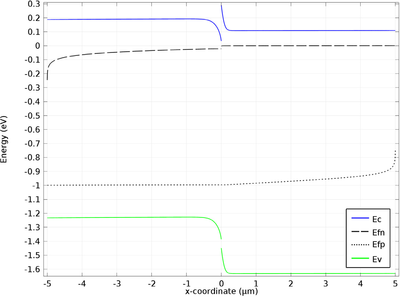
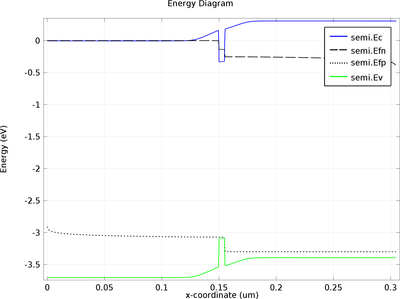
This benchmark model simulates three different heterojunction configurations under forward and reverse bias. It shows the difference in using the continuous quasi-Fermi level formulation versus the thermionic emission formulation for the charge transfer across the heterojunction. The ... En savoir plus
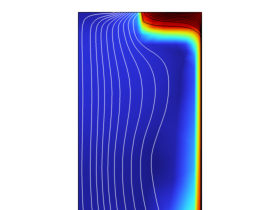
In this first half of a two-part example, a 2D model of a trench-gate IGBT is built, which will be extended to 3D in the second half. In general, it is the most efficient to start with a 2D model to make sure everything works as expected, before extending it to 3D. The Caughey&ndash ... En savoir plus
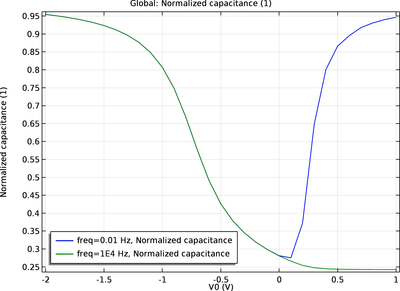
The metal-silicon-oxide (MOS) structure is the fundamental building block for many silicon planar devices. Its capacitance measurements provide a wealth of insight into the working principles of such devices. This tutorial constructs a simple 1D model of a MOS capacitor (MOSCAP). Both ... En savoir plus
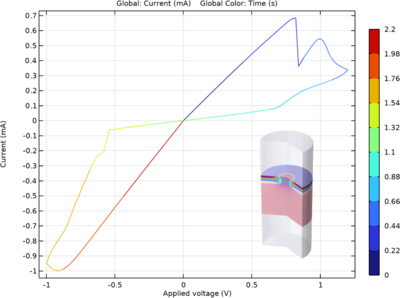
This model captures the dynamic resistive switching behavior of an oxide-based memristor. The device features a thin metal oxide layer sandwiched between two metal electrodes. When a voltage is applied, oxygen vacancies within the oxide layer migrate, acting as charge carriers and ... En savoir plus
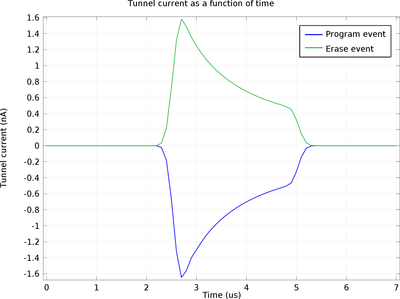
This model calculates the current and charge characteristics of a floating gate Electrically Erasable Programmable Read-Only Memory (EEPROM) device. A stationary study demonstrates the effects of varying the charge stored on the floating gate by computing Current-Voltage curves as a ... En savoir plus
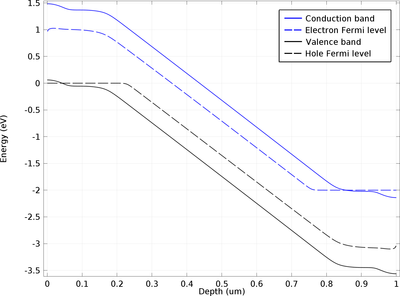
This simple model demonstrates how to use the Semiconductor Optoelectronics interfaces to model a simple GaAs PIN diode structure. Both the stimulated and spontaneous emission in the semiconductor are accounted for. The corresponding absorption of the light and the associated change in ... En savoir plus
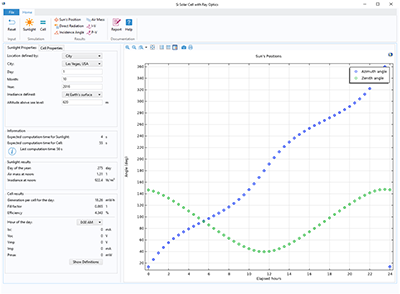
This app demonstrates the following: Multiple components (1D and 3D) in a single app Using the same choice list in the app as in the model using Data Access functionality Output numerical results for a specific time step using a combo box The app combines the Ray Optics Module and ... En savoir plus
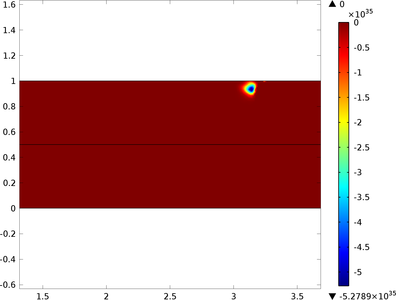
MOSFETs typically operate in three regimes depending on the drain-source voltage for a given gate voltage. Initially the current-voltage relation is linear, this is the Ohmic region. As the drain-source voltage increases the extracted current begins to saturate, this is the saturation ... En savoir plus
This model simulates a GaN based light emitting diode. The emission intensity, spectrum, and quantum efficiency are calculated as a function of the driving current. Direct radiative recombination across the band gap is modeled, as well as non-radiative Auger and trap-assisted ... En savoir plus
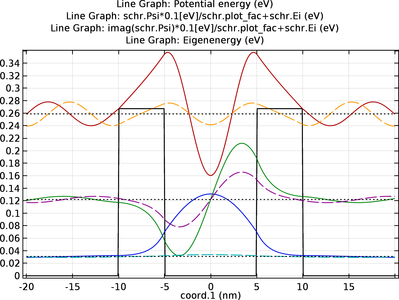
The double barrier structure is of interest because of its application in semiconductor devices such as resonant-tunneling diodes. This verification example demonstrates the Schrödinger Equation interface to set up a simple 1D GaAs/AlGaAs double barrier structure to analyze the ... En savoir plus


