
La Bibliothèque d'Applications présente des modèles construits avec COMSOL Multiphysics pour la simulation d'une grande variété d'applications, dans les domaines de l'électromagnétisme, de la mécanique des solides, de la mécanique des fluides et de la chimie. Vous pouvez télécharger ces modèles résolus avec leur documentation détaillée, comprenant les instructions de construction pas-à-pas, et vous en servir comme point de départ de votre travail de simulation. Utilisez l'outil de recherche rapide pour trouver les modèles et applications correspondant à votre domaine d'intérêt. Notez que de nombreux exemples présentés ici sont également accessibles via la Bibliothèques d'Applications intégrée au logiciel COMSOL Multiphysics® et disponible à partir du menu Fichier.
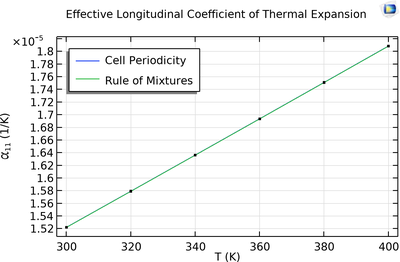
The homogenized material properties of a composite are computed based on the temperature-dependent properties of matrix and fiber. The homogenized parameters are compared to the analytical values derived from the rule of mixtures. This is an extension of model https://www.comsol.com ... En savoir plus

Beam theories are well-developed for slender structures with homogeneous materials and isotropic cross-sections. The traditional beam theories do no apply to beams made of different materials in the cross-section. Therefore, a homogenization-based numerical model is needed to compute ... En savoir plus

PCB is fabricated by laminating multiple materials, such as FR-4, copper, and resin, which exhibit significantly different coefficients of thermal expansion (CTE). When subjected to heating, the differential thermal expansion among these layers induces interlaminar deformation mismatch, ... En savoir plus

In this model, the stress concentrations around a superelliptic hole in a thin plate are investigated. To learn more about this model, see our accompanying blog post “Stress Concentrations Around a Superellipse”. En savoir plus
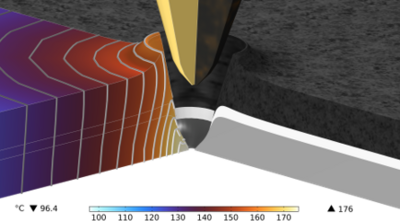
This model showcases a nail penetration experiment into a layered battery. It couples the Solid Mechanics, Lithium-Ion Battery, and Heat Transfer interfaces. A nail is punched into a sandwiched battery consisting of two electrodes and a separator. As soon as the nail connects both ... En savoir plus

This model demonstrates how to extract the lumped parameters for an mBVD equivalent circuit from a FEM simulation and how to leverage such a model directly using the Electrical Circuit interface. A 3D layered FBAR resonator is considered as an example. Related Blog Post Leveraging the ... En savoir plus


