- Bridging the Terahertz Gap
- Modeling the Lithium-Ion Battery
- Protection contre la Corrosion
- Modélisation des batteries
- Modélisation et Simulation dans le développement des piles à combustible
- Modélisation thermique des petits satellites
- Analyse électro-vibroacoustique d'un transducteur à armature équilibrée
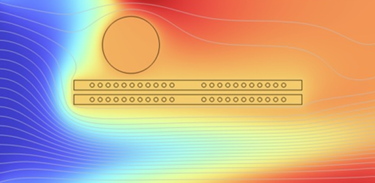
Thermo-Optic Response of Coupled Silicon Photonic Crystal Cavities under Packaging Airflow
Silicon photonic devices feature a high degree of integration and strong optical field confinement. However, the temperature rise induced by local optical absorption can lead to variations in the material refractive index, thereby affecting the optical resonance characteristics and mode distributions. To investigate the thermo-optic response of coupled silicon photonic crystal cavities under packaging airflow, a coupled optical–thermal–fluid multiphysics model was established using COMSOL Multiphysics. The model consists of two parallel silicon photonic crystal nanobeam defect cavities, an air-filled packaging domain, and a cylindrical flow-disturbing structure. The Electromagnetic Waves, Frequency Domain, Laminar Flow, and Heat Transfer in Solids and Fluids interfaces were employed. The coupled simulation was performed sequentially following the procedure of “cold-state optical eigenmode–steady-state flow and thermal fields–heated-state optical eigenmode,” while the thermo-optic effect of silicon was incorporated through a temperature-dependent refractive index. By parametrically varying the inlet airflow velocity, the effects of airflow variation on the local temperature distribution of the defect cavities, the temperature difference between the two cavities, and the optical eigenmodes were investigated. The simulation results show that the flow-disturbing structure modifies the local flow and heat-transfer characteristics around the photonic crystal cavities. Under different airflow conditions, the temperature distributions of the two cavities exhibit different degrees of asymmetry, which further leads to variations in the eigenfrequencies and optical field localization characteristics. This study reveals the multiphysics coupling among packaging airflow, local thermal gradients, and coupled optical modes, providing a numerical basis for thermal stability analysis and thermal design of silicon photonic device packaging.