
Lorenzo Bortot, CERN, Switzerland
Engineers and physicists at CERN go to great lengths to ensure that the high-power superconducting magnets that maintain the circular trajectory of particles inside the Large Hadron Collider (LHC) do not revert to a resistive state, an event known as a quench. To understand and prevent quench events, Lorenzo Bortot, an electrical engineer and research fellow at CERN, used numerical simulation to develop a multiphysics, multiscale, and multirate representation of the electrodynamics and thermal evolution of a quench event.
Suggested Stories
Keeping LEDs Cool Gets More Manageable Through Simulation
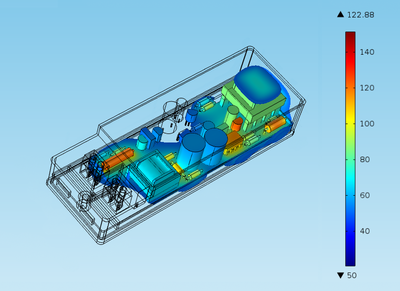
Light-emitting diodes (LEDs) offer many benefits over incandescent lighting, such as long life spans and high luminous ...

Modeling Helps Improve Safety in the Production of Teflon
BAM German Federal Institute for Materials Research & Testing in Berlin promotes industrial development by ...
Keynote: Ferrero — A New Challenge for Simulation
In this keynote talk from the COMSOL Conference 2024 Florence, Gabriele Ratto of Ferrero discusses how addressing food ...
ABB’s Electromagnetic Flowmeter Digital Twin Drives Performance
ABB built a digital twin of an electromagnetic flowmeter to mimic an actual flowmeter in a virtual environment. The ...


