
Harvey Buck, Roche Diagnostics Operations, Inc., Indianapolis, IN, USA
The test strips in glucose monitors, widely used by people with diabetes to maintain good health, are sensitive to chemical interferences and environmental conditions. The manufacturing process and electrode configuration of these strips also affects response accuracy. Researchers at Roche Diagnostics Operations, Inc. used multiphysics simulation to analyze the chemical reactions and voltage response in their glucometers.
Using COMSOL Multiphysics, Harvey Buck, principal scientist at Roche, investigated different configurations and materials used in the test strips. He analyzed the electrical response to an applied voltage during the chemical reaction catalyzed in a sample. Through numerical simulation, he predicted the sensitivity of electrical impedance measurements to mechanical properties of the sensor. He also optimized the electrode configuration, maximized sensitivity to cell fraction in a sample, and minimized sensitivity to manufacturing tolerances. These simulation results have given the Roche team a better understanding of their integrated sensor design for glucose monitoring.
Suggested Stories
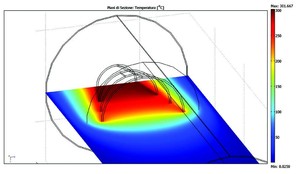
Around the Clock Solar Power
Italian utility ENEL and the Italian National Agency for New Technologies joined together to develop a new kind of ...
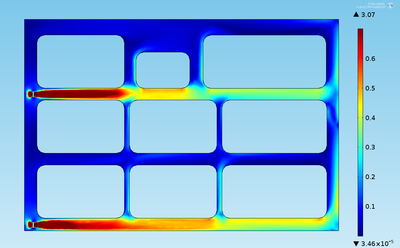
Battling Corrosion in Nuclear Waste Storage Facilities
Nuclear sites in Italy are being decommissioned, leaving questions about how to safely manage and store radioactive ...
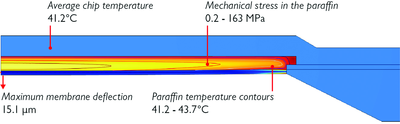
Actuation Technique for Miniature Robots Developed using Multiphysics Simulation
Robotic devices for minimally invasive surgery procedures require flexible tools and careful actuation. But most ...

Multiphysics Simulations Enable Development of Fast, Cheap MEMS-Based Bacteria Detector
Professor Mark Reed and his team at Yale University are using COMSOL Multiphysics to develop a MEMS-based solution for ...


