
W. Lee, K. Jensen
MIT, MA, USA
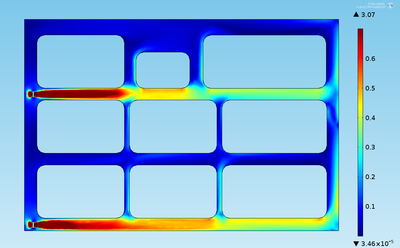
The chemical reactions used to generate solvents and certain pharmaceuticals rely on organic synthesis, a process of combining individual chemicals that can be accelerated through microwave heating. A microreactor system facilitates the direct, localized, and efficient temperature change necessary for successful synthesis. However, a uniform temperature distribution is crucial to the chemical process, and these reactions can be inhibited by unwanted temperature changes or heating that occurs too slowly. Wen-Hsuan Lee, a researcher at the Massachusetts Institute of Technology (MIT), fabricated a borosilicate glass microreactor to conduct this microwave organic synthesis, but when she tested her design in a microwave system, she discovered that the heating was uneven and below the desired temperature. Using COMSOL Multiphysics, she modeled the microreactor to investigate the effects of its geometry and orientation on the heating process. From her simulation results, she was able to redesign the microreactor and optimize its location and orientation in the microwave system to achieve successful organic synthesis.
Suggested Stories
Multiphysics Protects Wind Turbines when Lightning Strikes
Lightning Technologies, an NTS company, is a world leader in the design and validation of sophisticated lightning ...
Multiphysics Simulation Drives Smart City Technology
Traditional power boxes are bulky and too large. To design a power box that is more space-conscious, modular, and ...
Better Ways to Heat and Cool Buildings
Adsorptive climate control systems can reduce the power required to heat and cool buildings by running primarily on ...
Battling Corrosion in Nuclear Waste Storage Facilities
Nuclear sites in Italy are being decommissioned, leaving questions about how to safely manage and store radioactive ...


