
K. Suthar, C. Benmore
Argonne, IL, USA
As part of an industry that saves lives on a regular basis, pharmaceutical companies are in need of systems that can be used to deliver high-quality medicines. One method utilizes sound waves generated by an acoustic levitator with foam-coated transducers. Using the acoustic force from the sound waves, chemical particles are suspended between the transducers, where they can be mixed in a contaminant-free space.
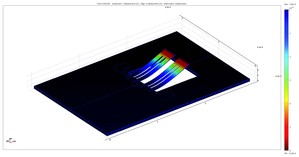
Using COMSOL Multiphysics, Kamlesh Suthar and Chris Benmore of Argonne National Laboratory have simulated an acoustic levitator in order to find the best geometry for controlling how liquid droplets form between the transducers. They also investigated the changes in viscosity and surface tension and the effects that such parameters have on the droplet shapes. Studying the fluid-structure interaction (FSI), Suthar explored the sound pressure levels, material properties, and geometry options for the levitator. Simulating the acoustic levitator helped them to hone their design and achieve a new degree of control over the interactions between droplets, which will ultimately contribute to life-saving advancements for pharmaceuticals.
Suggested Stories
Democratizing Simulation with Applications
Veryst Engineering, AltaSim Technologies, and GLL Bio-Med Analytics build applications in COMSOL Multiphysics ...

Améliorer les perspectives de la géothermie avec les forages inclinés
Les échangeurs géothermiques utilisent des forages pour extraire l'énergie du sous-sol afin de chauffer et de ...
Fine-Tuning the Factory: A Simulation App Helps Optimize an Additive Manufacturing Facility
Britain's Manufacturing Technology Centre, along with partners in the aerospace sector, has built an on-site powder ...
Easy and Accurate Measurement of Blood Viscosity
Microvisk Technologies develops and manufactures devices for measuring blood viscosity using the power of Micro ...


