
India's National Chemical Laboratory Optimizes Fuel Cells via Modeling
Ashish Lele, National Chemical Laboratory, India
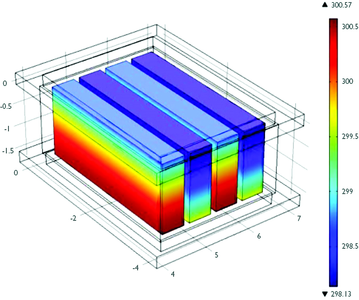
Inefficient and potentially harmful diesel generators are still the prevailing method of decentralized power generation for telecommunications in urban and rural India. Researchers at the National Chemical Laboratory are investigating proton exchange membrane (PEM) fuel cells, which are strong candidates for this industry because of their cleanliness, compatibility, and efficiency exceeding 30% (with work underway to further increase this value). Using multiphysics modeling and simulation, the researchers are working to determine an optimal configuration of fuel cell properties that yields maximum efficiency and performance.
Suggested Stories
Revving up Electrohydraulic Power Steering with Virtual Prototyping
In the automobile industry, the only thing faster than the cars that are produced is their design cycle. Validation ...
Get an Inside Look at an Innovative Rainwater Drainage System
Step into a busy neighborhood in Copenhagen, Denmark, to see how a multidisciplinary urban planning team used ...

Patterning Cells with the Flip of a Switch for Bioengineering Applications
Dielectrophoresis (DEP) is a method of patterning cells and particles used in medical, electronics, and energy ...
Simulation Helps Improve Atmosphere Revitalization Systems for Manned Spacecraft
To ensure astronaut safety on space missions, it is necessary to routinely revitalize the atmosphere in manned ...


