
General Atomics Designs Helicon Antenna for Tokamak with Simulation
Humberto Torreblanca, General Atomics, USA
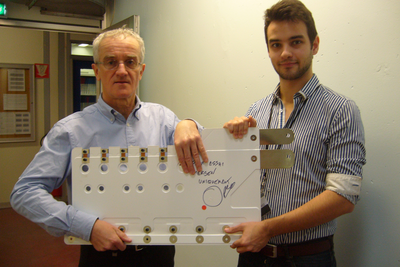
Built by engineers at General Atomics, the DIII-D tokamak needs to achieve temperatures that are 10 times hotter than the core of the Sun to achieve nuclear fusion. To accomplish this, a novel heating system using a helicon antenna that can inject 1 megawatt of RF power is being designed and built. Humberto Torreblanca, the DIII-D tokamak chief operator, and his team are using multiphysics simulation to model all aspects of the design, such as the magnetic field distribution inside and outside the tokamak vessel as well as the electric field distribution and RF losses of the helicon antenna.
Suggested Stories
Simulation App Introduces Personalized Oncology Care
iBMB, a spin-off of the University of Basilicata, developed a simulation app to help oncologists better monitor and ...
Magnetic Transmissions Increase Lifespan of Offshore Wind Farms
Sintex is a developer and manufacturer of magnetic couplings, systems that transmit torque and power with ...
From Nanoantennas to Deep Space Satellites, Electron Emission Enables Efficient Power Generation
Researchers from the Italian Institute of Technology (IIT) and the European Space Agency (ESA) are developing power ...
Control of Joule Heating Extends Performance and Device Life
Large electrical systems carrying high currents could pose a danger if any of their components, such as fuses and bus ...


