
NEXT ENERGY Analyzes Heat Transfer in Lithium-Ion Batteries
Gerd Liebig, Pamina Bohn, NEXT ENERGY EWE Research Centre for Energy Technology, Germany
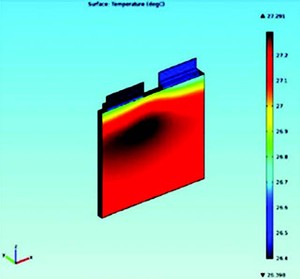
Lithium-ion batteries, which have a tendency to degrade at high temperatures, must adhere to stringent regulations guaranteeing their ability to withstand operating temperature fluctuations. Researchers at NEXT ENERGY used heat transfer modeling to study whether high welding temperatures can create enough temperature propagation within cells to cause irreversible damage, such as electrolyte decomposition and capacity loss. They discovered that tab welding can, in fact, induce irreversible damage, but laser welding is significantly less detrimental.
Suggested Stories
Seismic Safety Evaluations of Dams with Numerical Simulation
At Pisa University, numerical simulation is being used to study the accuracy of dam safety evaluations during ...

Restoration of Lake Water Environments
Human activity steals oxygen from natural water sources such as lakes and this oxygen-deficient water often contains ...
The Thermal Management of Li-ion Battery Packs
At the Fiat Research Center in Italy, Michele Gosso and Antonio Fiumara are working on the development of providing ...
How Fast Do Elevated Temperatures Reach the Cell Interior?
Lithium-ion batteries, which have a tendency to degrade at high temperatures, must adhere to stringent regulations ...


