
Simulation Helps Companies Assess Thermal Behavior of LED Devices
Aulis Tuominen and Mika Maaspuro
University of Turku
Turku, Finland
Toni Lopez
Philips Research
Eindhoven, The Netherlands
Sami Yllikäinen
Hella Lighting Finland Oy
Salo, Finland
Raimo Laitinen
Helvar Oy Ab
Karkkila, Finland
Light-emitting diodes (LEDs) offer many benefits over incandescent lighting, such as long life spans and high luminous efficiency, and they are environmentally friendly. One of the drawbacks, however, is that LEDs need to operate at the lowest possible temperatures and this must be carefully regulated.
Researchers at Business and Innovation Development Technology at the University of Turku in Finland have focused their attention on designing an efficient and inexpensive heat sink to regulate temperature. Simulation was crucial to their process as building prototypes is an expensive and time-consuming process.
Large manufacturing companies, such as Philips and Hella Lighting, use simulation to improve their LEDs as well. Simulation in COMSOL Multiphysics allows companies to determine the effect of new materials on the thermal behavior of the LED lighting device before a sample of that new material is even required for testing.
Suggested Stories
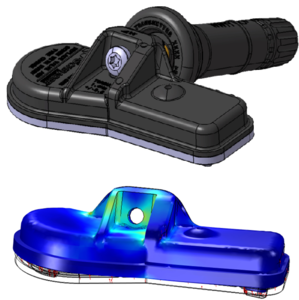
Optimizing Built-in Tire Pressure Monitoring Sensors
Built-in tire pressure sensors need to be able to withstand the wear and tear of working within a car’s tire rim. ...
Medtronic Advances Ablation Technology with Multiphysics Simulation
Researchers at Medtronic studied ablation technology using multiphysics simulation to enhance physicians' abilities to ...
Inspiring Young Engineers to Design for the Future at EPFL
EPFLoop, from the Swiss Federal Institute of Technology Lausanne (EPFL), designed their pod for the 2018 SpaceX ...
Optimizing Screen Protection During the Manufacturing Process
Cover glass, the screen surface material used for tablets and cell phones, offers exceptional smoothness, a mark-free ...


