
Simulation Helps Companies Assess Thermal Behavior of LED Devices
Aulis Tuominen and Mika Maaspuro
University of Turku
Turku, Finland
Toni Lopez
Philips Research
Eindhoven, The Netherlands
Sami Yllikäinen
Hella Lighting Finland Oy
Salo, Finland
Raimo Laitinen
Helvar Oy Ab
Karkkila, Finland
Light-emitting diodes (LEDs) offer many benefits over incandescent lighting, such as long life spans and high luminous efficiency, and they are environmentally friendly. One of the drawbacks, however, is that LEDs need to operate at the lowest possible temperatures and this must be carefully regulated.
Researchers at Business and Innovation Development Technology at the University of Turku in Finland have focused their attention on designing an efficient and inexpensive heat sink to regulate temperature. Simulation was crucial to their process as building prototypes is an expensive and time-consuming process.
Large manufacturing companies, such as Philips and Hella Lighting, use simulation to improve their LEDs as well. Simulation in COMSOL Multiphysics allows companies to determine the effect of new materials on the thermal behavior of the LED lighting device before a sample of that new material is even required for testing.
Suggested Stories
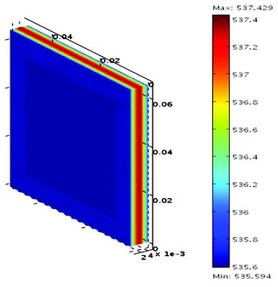
Battery Simulation Propels Electric Cars in China
Dr. Songrui Wang is a researcher at The Tianjin Institute of Power Sources, involved in battery testing and evaluation ...
Optimized Heating Process with Uniform Coating
Rautaruukki Oyj supplies metal-based components and systems to the construction and mechanical engineering industries, ...
Revving up Electrohydraulic Power Steering with Virtual Prototyping
In the automobile industry, the only thing faster than the cars that are produced is their design cycle. Validation ...
Switching Made Easy
Modern cars offer a wide range of complex functionality that comes with several design challenges. This story ...


