
Clemson Simulates Electrode Setup for Dielectrophoresis
G. Zhang
Clemson U, SC, USA
J. Brcka, J. Faguet, E. Lee
Tokyo Electron, TX, USA
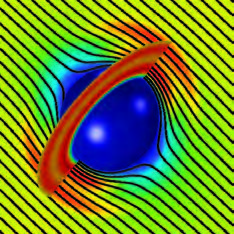
Dielectrophoresis (DEP) is a method of patterning cells and particles used in medical, electronics, and energy applications. When an electric field is applied to an array of cells or dielectric particles suspended in a medium, they become polarized, causing movement that reorganizes the particles. This is an efficient way to assemble materials layer by layer at the nanoscale, and is sometimes used in mass production of materials. Through a partnership between Clemson University and Tokyo Electron U.S. Holdings, Inc., researchers are analyzing unexpected particle rotation and alignments they have observed during cell patterning. They have used COMSOL Multiphysics models to understand cell patterns and material assembly; their simulations account for nonhomogeneous cell properties and electric field distortions, which they are analyzing to predict the influence of DEP force on this behavior.
Suggested Stories
Investigating Vibroacoustic Properties in Moth Wings for Acoustic Camouflage
Researchers at the University of Bristol modeled the acoustic camouflaging properties of moth wing scales to gain a ...
Metamaterials Make Physics Seem Like Magic
Metamaterials are manufactured, structured materials that they can interact and manipulate wave phenomena such that ...
Keynote: Leveraging Acoustics Simulation for Better Alexa® Devices
Watch this keynote talk to see how Amazon Lab126 uses the COMSOL Multiphysics® software to simulate and ...
Illuminating the Physics Behind Electromagnetics Concepts with Applications
Electrical engineering students find it hard to visualize the electromagnetics concepts they are learning. To remedy ...


