
Clemson Simulates Electrode Setup for Dielectrophoresis
G. Zhang
Clemson U, SC, USA
J. Brcka, J. Faguet, E. Lee
Tokyo Electron, TX, USA
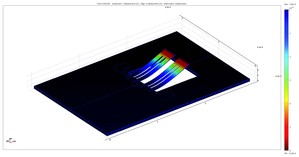
Dielectrophoresis (DEP) is a method of patterning cells and particles used in medical, electronics, and energy applications. When an electric field is applied to an array of cells or dielectric particles suspended in a medium, they become polarized, causing movement that reorganizes the particles. This is an efficient way to assemble materials layer by layer at the nanoscale, and is sometimes used in mass production of materials. Through a partnership between Clemson University and Tokyo Electron U.S. Holdings, Inc., researchers are analyzing unexpected particle rotation and alignments they have observed during cell patterning. They have used COMSOL Multiphysics models to understand cell patterns and material assembly; their simulations account for nonhomogeneous cell properties and electric field distortions, which they are analyzing to predict the influence of DEP force on this behavior.
Suggested Stories
Optimizing 3D Printing Techniques with Simulation Apps
3D printing has recently revolutionized manufacturing techniques, influencing countless industries and products. The ...
Easy and Accurate Measurement of Blood Viscosity
Microvisk Technologies develops and manufactures devices for measuring blood viscosity using the power of Micro ...
From Nanoantennas to Deep Space Satellites, Electron Emission Enables Efficient Power Generation
Researchers from the Italian Institute of Technology (IIT) and the European Space Agency (ESA) are developing power ...
Shake, Rattle, and Roll
The Norwegian Geotechnical Institute (NGI) is an international center for research and consulting that investigates ...


