
F. De Vita, S. Di Marco, F. Costa and P. Turchi
Altran, Italy
Stealth airplanes and ships avoid radar detection by optimizing the shape of surfaces to reflect away from the radar source or absorb its energy. Yet, if a ship or aircraft’s antenna for communication purposes is to operate properly, it cannot be completely covered up. This makes it one of the remaining components with a large radar cross section and can essentially destroy the overall system’s invisibility to radar.
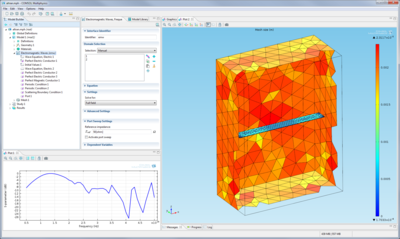
Altran, a global leader in innovation and high-tech engineering consulting, set out to design frequency selective surfaces with geometrical patterns that would optimize the stealth technology. The performance of a FSS is linked to its shape, thickness, choice of substrates and the phasing between individual elements. There are many possibilities, and testing each one physically would be time consuming for designers. Altran turned to simulation with COMSOL Multiphysics to investigate the frequency responses of a variety of shapes and sizes and how they are distributed on a surface in order to find promising candidates in just minutes.
Suggested Stories
The Sound of Perfection Thanks to the Modeling of Acoustic Metasurfaces
At the École Polytechnique Fédérale de Lausanne (EPFL), engineers have designed an acoustic metasurface that could be ...
Picking the Pattern for a Stealth Antenna
Stealth airplanes and ships avoid radar detection by optimizing the shape of surfaces to reflect away from the radar ...

Sonar Dome Vibration Analysis
There has been a recent move towards utilizing bulbous bows on ships to house different types of sonar systems, but it ...
Boeing Simulates Thermal Expansion in Composites with Expanded Metal Foil for Lightning Protection of Aircraft Structures
Carbon fiber composites are used extensively throughout the body of modern aircraft, such as the Boeing 787 ...


