
Shuya Yoshioka
Ritsumeikan University
Shiga, Japan
Human activity steals oxygen from natural water sources such as lakes and this oxygen-deficient water often contains high levels of toxic substances such as metals and organic material. Thus the number of lakes that can be used as a source of water is reduced, straining the available resources and creating a need for water-treatment plants of water which can have negative impacts when powered using fossil fuels.
Treating this oxygen-deficient water can be done by injecting oxygen microbubbles into the water to oxidize the metals and cause them to precipitate and stimulate the activity of mircro-organisms that breach down organic material. In testing the volume of microbubbles needed and the appropriate size of those bubbles, a team at Ritsumeikan University in Japan used COMSOL Multiphysics to predict all environmental phenomena having an impact on the body of water (wind, water flow, temperature, chemical reactions, and diffusion).
The team was able to test optimal depth and location for the introduction of the microbubbles in the Sounoseki Dam and is now using COMSOL Multiphysics to apply this process in other locations.
Suggested Stories
Les merveilles insoupçonnées du rayonnement thermique pour le chauffage, le refroidissement et la fonte de la neige
Viega conçoit des systèmes de chauffage et de refroidissement par rayonnement pour des applications résidentielles et ...
Lighting the Way for Improved Synchrotron Vacuum Chambers at RadiaSoft
One of the goals of the Argonne National Laboratory (ANL) is to increase the brightness of synchrotron beams for the ...
Illuminating Complex Material Behavior with Multiphysics Simulation
At Canadian Nuclear Laboratories, multiphysics simulation is used to gain insight into the behavior of nuclear fuel ...
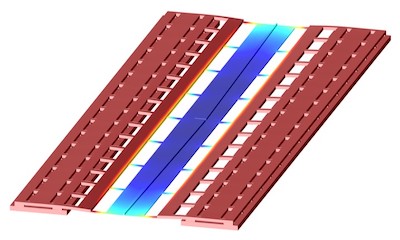
Designing a Silicon Photonic MEMS Phase Shifter with Simulation
Researchers at the Swiss Federal Institute of Technology Lausanne are using simulation to optimize the optical and ...


