
Ivana Milanovic, University of Hartford, USA
While covering the required fundamental material in undergraduate academic programs is the top priority, students require an extra set of knowledge and skills to flourish in the workforce. This is especially true in science, technology, engineering, and mathematics (STEM) fields, where there is rarely an abundance of time for inquiry-based learning and the development of field-specific skills. To address this issue, the University of Hartford integrated multiphysics modeling into their curricula. Using the Application Builder in the COMSOL Multiphysics® software, the university created simulation-based laboratory assignments through apps, which enhanced students’ physical intuition and their ability to visualize physical concepts.
Suggested Stories

Améliorer les perspectives de la géothermie avec les forages inclinés
Les échangeurs géothermiques utilisent des forages pour extraire l'énergie du sous-sol afin de chauffer et de ...
Designing the Gold Standard of Immersive Audio for Virtual Reality Gaming
Tectonic Audio Labs used electromagnetics, mechanical, and acoustics simulation to develop a state-of-the-art balanced ...
Designing a Miniaturized Wastewater Treatment Plant for Micropollutant Degradation
Eden Tech uses multiphysics simulation to design a miniaturized wastewater treatment system made from compact discs. ...
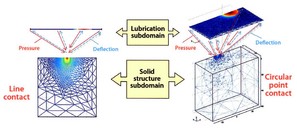
Shape Changing Lubricants
Shell Global Solutions UK is conducting research to optimize lubricants for the fuel economy. A problem exists in ...


