
Ivana Milanovic, University of Hartford, USA
While covering the required fundamental material in undergraduate academic programs is the top priority, students require an extra set of knowledge and skills to flourish in the workforce. This is especially true in science, technology, engineering, and mathematics (STEM) fields, where there is rarely an abundance of time for inquiry-based learning and the development of field-specific skills. To address this issue, the University of Hartford integrated multiphysics modeling into their curricula. Using the Application Builder in the COMSOL Multiphysics® software, the university created simulation-based laboratory assignments through apps, which enhanced students’ physical intuition and their ability to visualize physical concepts.
Suggested Stories
Manipulate and Control Sound: How Mathematical Modeling Supports Cutting-Edge Acoustic Metamaterials Research
Researchers at Duke University are using numerical modeling to develop metamaterial structures for acoustic cloaking. ...
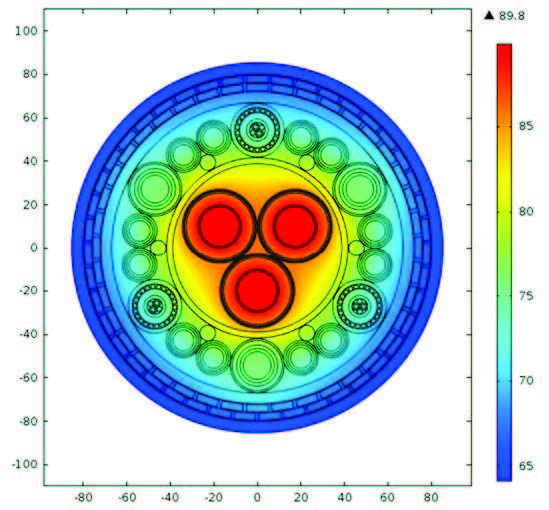
Simulation Software Brings Big Changes to Cable Industry
The design and testing of high-voltage cables for terrestrial and submarine applications is paramount to Prysmian's ...
Investigating Vibroacoustic Properties in Moth Wings for Acoustic Camouflage
Researchers at the University of Bristol modeled the acoustic camouflaging properties of moth wing scales to gain a ...
Développement d’un nouveau modèle de batterie pour répondre à des questions classiques de chimie
Des chercheurs de l'Institut Flamand de Recherche Technologique (VITO/EnergyVille) et de l'Université Catholique de ...


