
Researchers in Germany Simulate Corrosion Protection for Submarines
David Schaefer
University of Duisburg-Essen, Duisburg, Germany
Germany's Technical Center for Ships and Naval Weapons, Bundeswehr, Germany
Submarines create underwater electric potential (UEP) signatures when using corrosion protection systems. These signatures are detectable by enemy vessels, an undesirable effect of the corrosion protection. Germany’s Technical Center for Ships and Naval Weapons (WTD 71) has worked with the Laboratory for General and Theoretical Electrical Engineering (ATE) at the University of Duisburg-Essen to research these UEP signatures in order to reduce them.
Using COMSOL, the team simulated the electric potential distribution on the hull of a submarine, indicating whether or not the material is protected from corrosion. The higher the electric potential, the more the hull is protected. After this, they modeled the signature left by the different electric potentials. The general notion was that a higher amount of corrosion leads to a more detectable signal, which is mostly true. Furthermore, the results showed that the signature is actually the least detectable between zero corrosion protection and the standard operating conditions for full corrosion protection.
Suggested Stories
Designing Next-Generation CO2 Removal Technology for Better Life in Space
NASA combines thermal modeling and experimental testing to find the best compressor design for the system that keeps ...
Keynote: The Role of FEA Simulations in Electrifying Aviation
In this keynote talk, Mustafa Baris Topçuoglu discusses aerospace company GKN Fokker Elmo's research- and customer ...
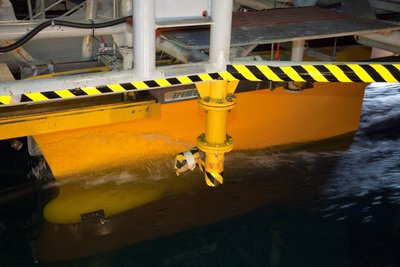
Sonar Dome Vibration Analysis
There has been a recent move towards utilizing bulbous bows on ships to house different types of sonar systems, but it ...
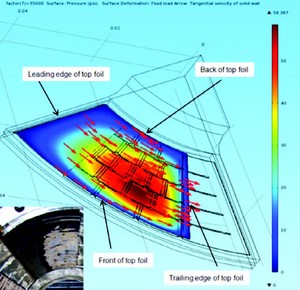
Multiphysics Analysis of CO2 Foil Thrust Bearing Characteristics
Knolls Atomic Power Laboratory (KAPL) is a research and development facility supporting the United States Naval ...


