
Defining Surface Plasmon Resonance Effects with Simulation
Sergei Yushanov, Jeffrey S. Crompton, Luke T. Gritter, and Kyle C. Koppenhoefer
AltaSim Technologies
Columbus, OH
USA
Surface Plasmon Resonance (SPR) is created by surface plasmons, coherent electron oscillations existing between any two materials where the real part of the dielectric function changes sign across the interface. SPR technology is based on the electromagnetic field component of incident light penetrating into a surface and it can be used to detect molecular adsorption on surfaces.
Plasmon excitation typically exists in two configurations: the Kretschmann-Raether configuration, where a thin metal film is sandwiched between a dielectric and air, and the incident wave is from the dielectric side; and the Otto configuration, where an air gap exists between the dielectric and the metal. Using COMSOL Multiphysics, the effect of the SPR on the electromagnetic field can be defined, which has allowed for the measurement of surface contaminants and nano-scale photonic devices.
Suggested Stories

Détecter la corrosion dans les conduites encastrées à l'aide de la simulation
Une nouvelle approche utilise des ondes guidées générées par la technologie EMAT afin de détecter la corrosion dans ...
Analyzing a Timeless Tradition Found in Ultra-Luxury Watches
Engineers at HEPIA, HES-SO Geneva are fine-tuning luxury-watch minute repeaters with a surrogate-model-led process ...
Developing Ultrathin Dolby Atmos® Enabled Speaker Technology for Home Entertainment Systems
3D surround sound technology creates a premium and fully immersive audio experience for consumers. Dolby Laboratories ...
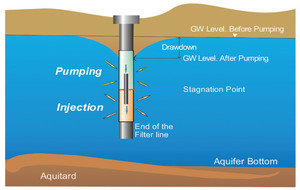
Pumping and Injecting from a Single Borehole
Professor Dr. Martin Sauter leads a group at the University of Göttingen in research on hydrogeology. Cooperating with ...


