
Matthias Richwin,
Leopold Kostal GmbH,
Dortmund, Germany
Modern cars offer a wide range of complex functionality that comes with several design challenges. This story discusses some of the necessary updates to a roof module in a premium car and the charging system of an electric car.
The roof module of a particular model houses several components. 90% of the generated heat goes into its printed circuit board (PCB), so temperature control is vital for correct functioning. In addition, there is a call from customers for touch-screen-style sensors, as they are used to this functionality from their mobile devices. COMSOL user Matthias Richwin works at KOSTAL, a company that develops and manufactures mechatronic products for the automotive manufacturing industry, and with his team used simulation to model the roof module's thermal behavior and the capacitive sensor’s sensitivity and electrostatic properties. The team considered different sizes of finger and thumb pads along with the possibility of factors like gloves or hand cream.
KOSTAL also developed an inductive power transfer charging system for charging car batteries without the use of cables. Simulation allowed them to find a coil geometry that works as efficiently as a cable-based system.
Suggested Stories
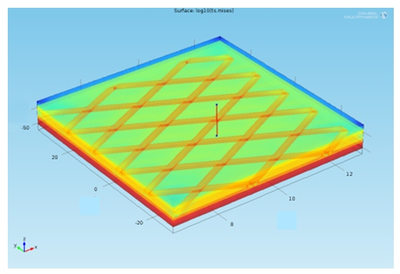
Boeing Simulates Thermal Expansion in Composites with Expanded Metal Foil for Lightning Protection of Aircraft Structures
Carbon fiber composites are used extensively throughout the body of modern aircraft, such as the Boeing 787 ...
Express Delivery: Simulation App Speeds Up Electric Truck Battery Design
Volvo Trucks is using a simulation app to help optimize electric truck batteries. The app can be used to help produce ...
Making Biofuel a Cost-Effective, Renewable Source of Energy
Pyrolysis is a pre-commercial thermochemical process that converts renewable, plant-based materials such as wood into ...
Simuler pour améliorer les performances des jauges à ionisation
La fabrication de semi-conducteurs et la recherche en physique des particules s’effectuent dans des conditions de vide ...


