
Conformément à notre Politique de qualité, COMSOL maintient une bibliothèque de centaines d'exemples de modèles documentés qui sont régulièrement testés avec la dernière version du logiciel COMSOL Multiphysics®, notamment des benchmarks de référence en provenance de l'ASME et de NAFEMS, ainsi que des problèmes TEAM.
Notre suite de tests de vérification et de validation (V&V) fournit des solutions précises qui sont comparées aux résultats analytiques et aux données de référence établies. Les modèles documentés ci-dessous font partie des bibliothèques d'applications intégrées du logiciel COMSOL Multiphysics®. Ils comprennent des valeurs de référence et des sources documentaires pour un large éventail de benchmarks, ainsi que des instructions étape par étape pour reproduire les résultats attendus dans votre propre environnement de travail. Vous pouvez utiliser ces modèles non seulement pour documenter vos efforts en matière d'assurance qualité logicielle (SQA) et de vérification de code numérique (NVC), mais aussi dans le cadre d'un programme de formation interne.
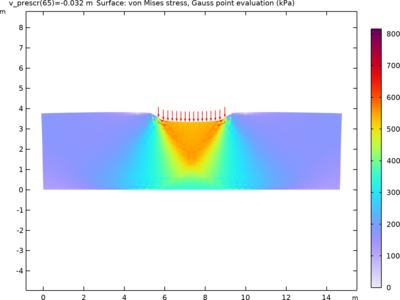
A common verification problem for geotechnical problems is a shallow stratum layer of clay. In this example a vertical load is applied on the clay strata and the static response and the collapse load are studied. The clay is modeled as an elastic-perfectly plastic material and the ... En savoir plus

This example demonstrates the bending analysis of a simply supported composite laminate under sinusoidal distributed transverse load. The composite laminate is thick, with a thickness to side length ratio of 1/4. The laminate has three layers in a cross-ply layup. The model is solved ... En savoir plus
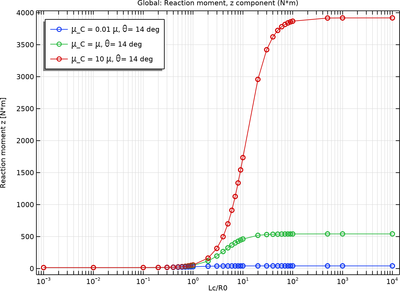
In this example, it is demonstrated how to extend the built-in linear elastic material model to a Cosserat material through the addition of microrotation degrees of freedom. A cylindrical bar under pure torsion is analyzed and the effect of the Cosserat length scale parameter on the ... En savoir plus
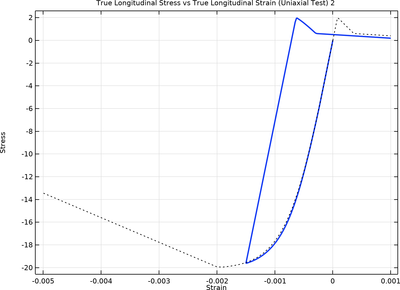
This example shows the behavior of the coupled damage-plasticity material model for concrete when subjected to different loading conditions. En savoir plus
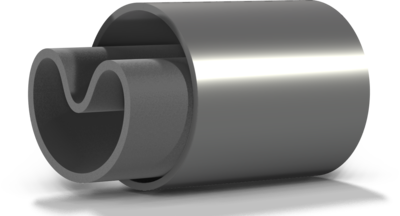
In this example, the Bergstrom–Bischoff material model is used to model the temperature and strain dependent behavior of High Density Polyethylene (HDPE) used, for example, to make liners for damaged pipes in oil and gas applications, or to make type IV hydrogen storage vessels for fuel ... En savoir plus

The vibration modes of a thin or thick circular disc are well known, and it is possible to compute the corresponding eigenfrequencies to arbitrary precision from a series solution. The same is true for the acoustic modes of an air-filled cylinder with perfectly rigid walls. A more ... En savoir plus
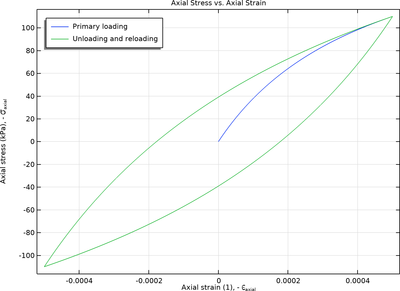
The small strain overlay material model captures the effect of high stiffness at low strain as well as the hysteresis under cyclic loading, which is a common effect for most soils. The formulation allows stiffness degradation with an increase in shear strain, and the full recovery of ... En savoir plus
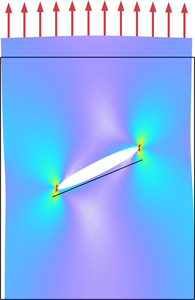
This example reproduces a NAFEMS benchmark in which a plate with an angle crack is subjected to tensile loading. The J-integral is calculated and the stress intensity factors for Mode I and Mode II are compared to the benchmark results for several crack angles. En savoir plus
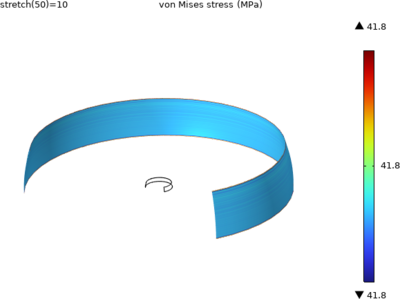
This version of the balloon inflation example demonstrates how the Shell and Membrane interfaces can be used to model thin structures made of hyperelastic materials. The example is identical to the Model Library model 'Inflation of a spherical rubber balloon', except that the Membrane ... En savoir plus
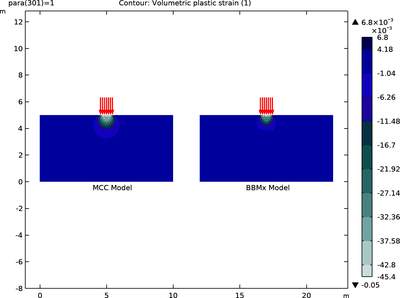
In this example, a settlement and heave analysis of a shallow foundation resting on an unsaturated soil stratum is conducted with the Modified Cam-Clay and Extended Barcelona Basic soil models. The effect of pore suction due to movements in the phreatic line and the resulting settlement ... En savoir plus


