
Fundamental Eigenfrequency of a Rotating Blade
Application ID: 9288
The eigenfrequencies of a rotating blade are studied in this benchmark. It shows how stress stiffening and spin softening affect the fundamental eigenfrequency.
High rotational speeds in rotating machinery can result in centrifugal forces of considerable magnitude. The forces induced by the rotation give rise to two counteracting effects: stress stiffening and spin softening (or centrifugal softening). The former is caused by the stationary stress field created by the centrifugal force and increases the stiffness of the body, and so increase its resonance frequencies. At the same time, any radial displacement away from the axis of rotation increases the centrifugal force, while motion toward the axis decreases it. This application shows how the combined effect of stress stiffening and spin softening affects the fundamental eigenfrequencies of a blade attached to a rotating shaft. The eigenfrequencies obtained from the model are compared with analytical solutions.
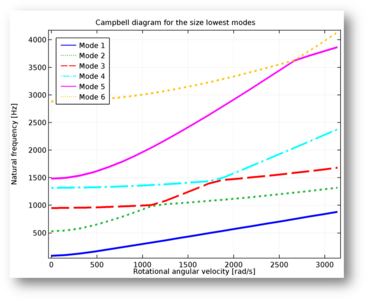
The model also illustrates how to add the effect of Coriolis forces. Furthermore, a parametric study is performed to evaluate the effect of the angular velocity of rotation on the eigenfrequencies of the blade. The results are represented in the form of a Campbell diagram.
This model example illustrates applications of this type that would nominally be built using the following products:
however, additional products may be required to completely define and model it. Furthermore, this example may also be defined and modeled using components from the following product combinations:
- COMSOL Multiphysics® et
- soit le Module Acoustics, Module MEMS, Module Multibody Dynamics, ou Module Structural Mechanics
The combination of COMSOL® products required to model your application depends on several factors and may include boundary conditions, material properties, physics interfaces, and part libraries. Particular functionality may be common to several products. To determine the right combination of products for your modeling needs, review the Grille des Spécifications and make use of a free evaluation license. The COMSOL Sales and Support teams are available for answering any questions you may have regarding this.


