
La Bibliothèque d'Applications présente des modèles construits avec COMSOL Multiphysics pour la simulation d'une grande variété d'applications, dans les domaines de l'électromagnétisme, de la mécanique des solides, de la mécanique des fluides et de la chimie. Vous pouvez télécharger ces modèles résolus avec leur documentation détaillée, comprenant les instructions de construction pas-à-pas, et vous en servir comme point de départ de votre travail de simulation. Utilisez l'outil de recherche rapide pour trouver les modèles et applications correspondant à votre domaine d'intérêt. Notez que de nombreux exemples présentés ici sont également accessibles via la Bibliothèques d'Applications intégrée au logiciel COMSOL Multiphysics® et disponible à partir du menu Fichier.

In many structural dynamics applications, some components are stiff compared to the supporting structure. Such a stiff part will only contribute to the dynamic properties of the structure through its mass and moment of inertia. It is then possible to reduce the model size significantly ... En savoir plus
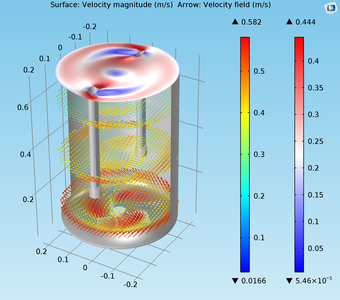
This example of turbulent flow in a partially baffled turbulent mixer shows how to set up The Rotating Machinery, Turbulent Flow interfaces from the Mixer Module with free surface and stationary free surface features. Both frozen rotor and time-dependent simulations are performed and ... En savoir plus
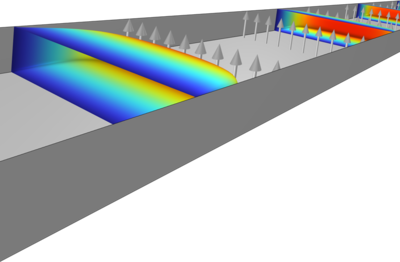
In nuclear fusion reactors, the conducting fluid, such as the fusion plasma and the liquid metal in the reactor blanket, will interact with the background magnetic field. This phenomenon is referred to as magnetohydrodynamics (MHD). The electromagnetic field and fluid flow are fully ... En savoir plus

The thermal stress in a layered plate is studied in this example. A plate consisting of two layers, a coating and a substrate layer, is stress and strain free at 800 degrees C. The temperature of the plate is reduced to 150 degrees C and thermal stresses are induced due to the difference ... En savoir plus
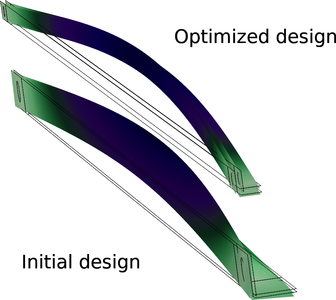
Buckling is a common failure mode for slender structural components. This model shows how the buckling load of a diagonal brace can be maximized, while constraining the volume of the brace. En savoir plus
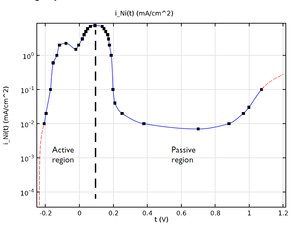
This model exemplifies the basic principles of crevice corrosion and how a time-dependent study can be used to simulate the electrode deformation. The model is in 2D and the polarization data for the corrosion reaction is taken from a paper by Absulsalam and others. The model and the ... En savoir plus
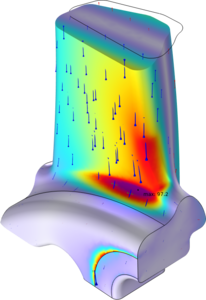
This tutorial uses the submodeling technique to accurately resolve the stress concentrations in a wheel rim. First a global model is solved to obtain the displacements, which are then used as boundary conditions in a local model of the region where the stress concentrations occur. En savoir plus
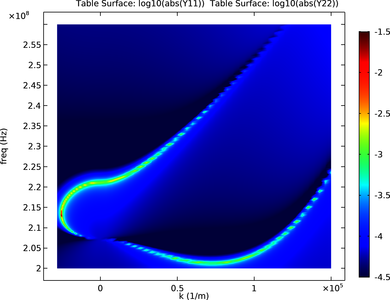
This model shows how to create dispersion diagrams from simulation results by extending the tutorial Thin-Film BAW Composite Resonator. The dispersion curve can be plotted against both real and imaginary values of the wave number, corresponding to the propagating modes and evanescent ... En savoir plus
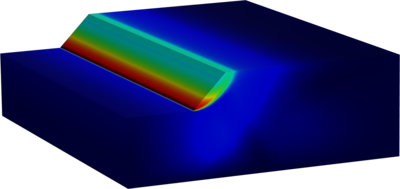
The strength reduction technique is a tool to find the factor of safety (FOS) in geotechnical problems, particularly in slope stability analyses. To determine the factor of safety of the slope, the strength properties in the Mohr–Coulomb model are gradually reduced until failure occurs. ... En savoir plus
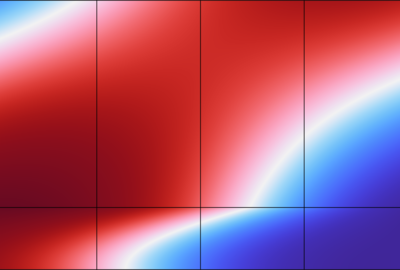
This tutorial investigates the acoustic properties of a porous layer made of glass wool. The porous material has transverse isotropic properties and is modeled with the full anisotropic poroelastic material model. En savoir plus