
La Bibliothèque d'Applications présente des modèles construits avec COMSOL Multiphysics pour la simulation d'une grande variété d'applications, dans les domaines de l'électromagnétisme, de la mécanique des solides, de la mécanique des fluides et de la chimie. Vous pouvez télécharger ces modèles résolus avec leur documentation détaillée, comprenant les instructions de construction pas-à-pas, et vous en servir comme point de départ de votre travail de simulation. Utilisez l'outil de recherche rapide pour trouver les modèles et applications correspondant à votre domaine d'intérêt. Notez que de nombreux exemples présentés ici sont également accessibles via la Bibliothèques d'Applications intégrée au logiciel COMSOL Multiphysics® et disponible à partir du menu Fichier.
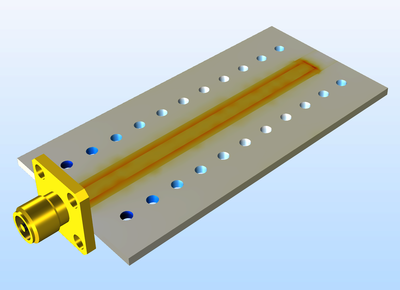
SMA connectors are popularly used on printed circuit boards (PCB) for testing. This model shows how to excite an SMA connector on a microwave substrate and how to terminate a grounded coplanar waveguide (GCPW) with 50 ohm using a lumped port and an air-bridge. En savoir plus
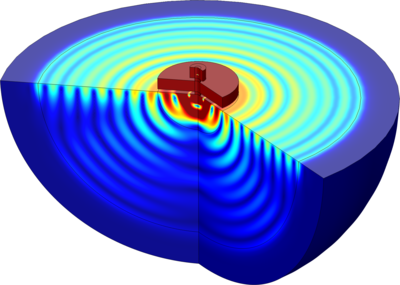
This model shows how to compute the anchor loss limited quality factor of a diamond disc resonator. The resonator is anchored to the substrate by a polysilicon post and power is transmitted to the substrate through the post. A perfectly matched layer is used to represent the essentially ... En savoir plus
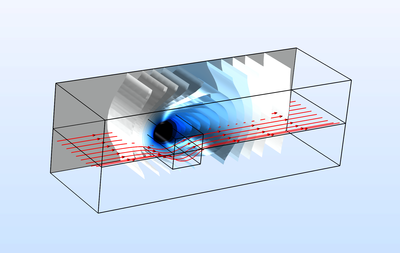
This example is a benchmark problem for simulating phase change in porous media. It studies the melting process of an ice inclusion within porous media and therefore demonstrates how to couple Darcy's Law with the Heat Transfer in Porous Media interface including phase change. En savoir plus
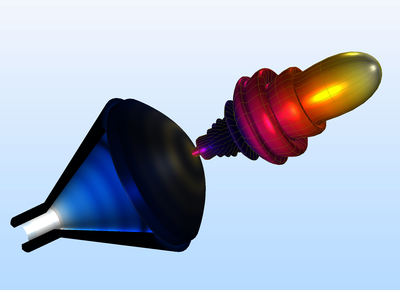
An axisymmetric 3D structure such as a conical horn antenna can be simulated in a fast and efficient way using only its 2D layout. In this model, the antenna radiation and matching characteristics are computed very quickly with respect to the dominant TE mode from the given circular ... En savoir plus
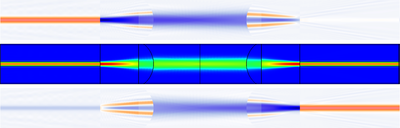
Focusing a laser beam onto the tip of a single mode fiber is a common way to couple light. To achieve good coupling efficiency, the spatial mode of the light field has to match the spatial mode of the fiber. In this model, we use the beam envelopes method to compute a small free-space ... En savoir plus
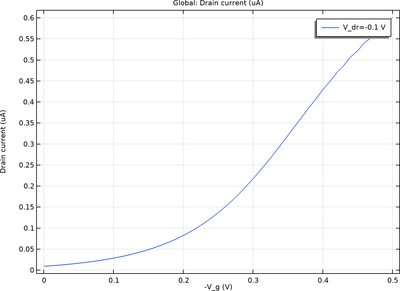
This model shows how to model an electrolyte-gated organic field-effect transistor based on a general drift–diffusion model. The model uses the Transport of Charge Carriers interface and the Electrostatics interface. The transistor characteristics are visualized. Formation of the EDLs in ... En savoir plus
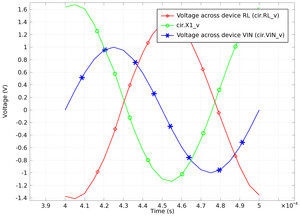
This model shows how to combine an electric circuit simulation with a finite element simulation. The finite element model is an inductor with a nonlinear magnetic core and 1000 turns, where the number of turns is modeled using a distributed current technique. The circuit is imported ... En savoir plus
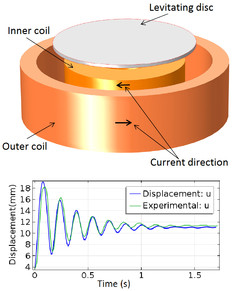
This model presents a solution to the Transient Electromagnetic Analysis Methods (TEAM) workshop problem 28, “An Electrodynamic Levitation Device”- a benchmark problem involving the dynamic coupling of electromagnetics and rigid body dynamics. An electrodynamic levitation force is ... En savoir plus
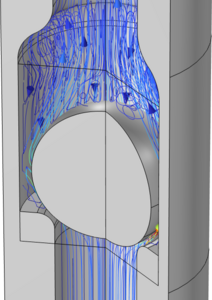
Using a Fluid-Solid Interaction multiphysics interface, the behavior of a spring-loaded ball check valve is studied under varying functional and reverse flow. The fluid force acting on the ball opens the valve at the opening pressure. In the case of a reversed pressure, the ball comes ... En savoir plus
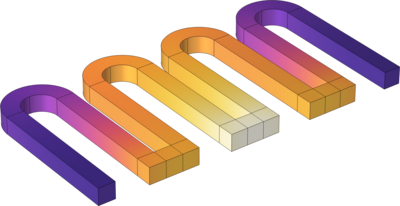
This model analyzes the thermal expansion in a MEMS device, such as a microgyroscope, where thermal expansion should be minimized. The device is made from the copper-beryllium alloy UNS C17500 and uses temperature-dependent material properties from the Material Library. The purpose of ... En savoir plus


