
La Bibliothèque d'Applications présente des modèles construits avec COMSOL Multiphysics pour la simulation d'une grande variété d'applications, dans les domaines de l'électromagnétisme, de la mécanique des solides, de la mécanique des fluides et de la chimie. Vous pouvez télécharger ces modèles résolus avec leur documentation détaillée, comprenant les instructions de construction pas-à-pas, et vous en servir comme point de départ de votre travail de simulation. Utilisez l'outil de recherche rapide pour trouver les modèles et applications correspondant à votre domaine d'intérêt. Notez que de nombreux exemples présentés ici sont également accessibles via la Bibliothèques d'Applications intégrée au logiciel COMSOL Multiphysics® et disponible à partir du menu Fichier.
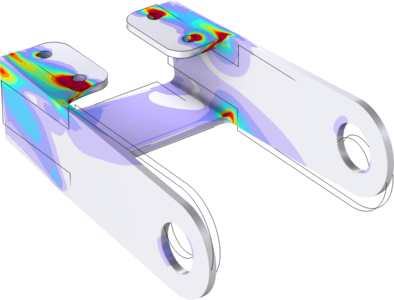
The bracket model tutorials are used as an introduction to the features and functionality within the Structural Mechanics Module. The following features are introduced: The following features are introduced: The fundamentals: static linear analysis Parametric study Including initial ... En savoir plus
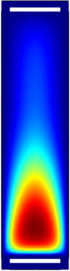
DC glow discharges in the low-pressure regime have long been used for gas lasers and fluorescent lamps. DC discharges are attractive to study because the solution is time independent. The 1D and 2D models show how to use the DC Discharge interface to set up an analysis of a positive ... En savoir plus
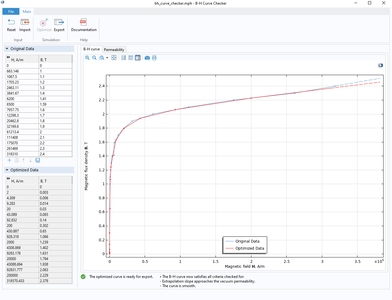
This app demonstrates the following: Importing measured data from a text file Handling measured data using methods Exporting the results to a text file. The app can be used to verify and optimize B–H curves using experimental data. It also generates curve data in the over-fluxed ... En savoir plus
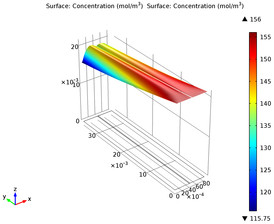
This 2D example of a vanadium flow battery demonstrates how to couple a secondary current distribution model for an ion-exchange membrane to tertiary current distribution models for two different free electrolyte compartments of a flow battery. The Ion-Exchange Membrane boundary node ... En savoir plus
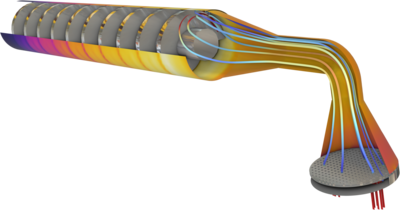
This tutorial example of the pasta extrusion process shows how to simulate the non-isothermal flow of dough in the metering zone of a pasta extruder accounting for the temperature dependent material properties of the hydrated semolina dough. En savoir plus
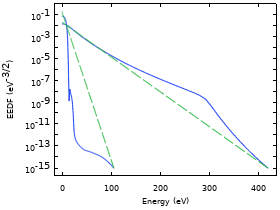
This tutorial models a DC glow discharge by solving fluid-type plasma equations fully coupled with the homogeneous and time-independent electron Boltzmann equation in the classical two-term approximation. The approximated Boltzmann equation is solved for each position of space and is ... En savoir plus
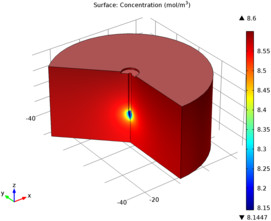
This tutorial example serves as an introduction to the Corrosion Module and models the metal oxidation and oxygen reduction current densities on the surface of a galvanized nail, surrounded by a piece of wet wood, which acts as electrolyte. The protecting zinc layer on the nail is not ... En savoir plus
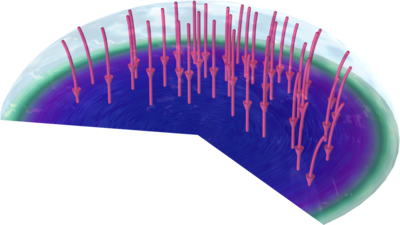
An Evans droplet experiment is a century-old corrosion experiment for demonstrating oxygen transport-limited corrosion. A droplet of water is placed on a metal surface, and over time the surface features differences in the radial direction of the surface in terms of amount of corroded ... En savoir plus
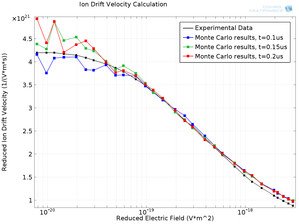
The drift velocity of Ar+ is calculated using a Monte Carlo simulation in which the elastic collisions of Argon ions with ambient neutrals are explicitly modeled. The model uses energy-dependent collision cross-section data from experiment. The average ion velocity values are consistent ... En savoir plus
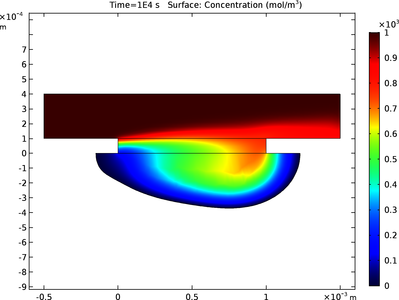
This example illustrates the principle of wet chemical etching for 2D geometry under laminar flow. The purpose of this tutorial is to examine how the copper substrate material is depleted and how the cavity shape evolves during the wet etching process. Wet chemical etching is ... En savoir plus