
La Bibliothèque d'Applications présente des modèles construits avec COMSOL Multiphysics pour la simulation d'une grande variété d'applications, dans les domaines de l'électromagnétisme, de la mécanique des solides, de la mécanique des fluides et de la chimie. Vous pouvez télécharger ces modèles résolus avec leur documentation détaillée, comprenant les instructions de construction pas-à-pas, et vous en servir comme point de départ de votre travail de simulation. Utilisez l'outil de recherche rapide pour trouver les modèles et applications correspondant à votre domaine d'intérêt. Notez que de nombreux exemples présentés ici sont également accessibles via la Bibliothèques d'Applications intégrée au logiciel COMSOL Multiphysics® et disponible à partir du menu Fichier.
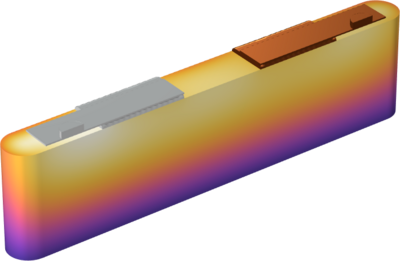
This model exemplifies how to compute the internal temperature distribution in a prismatic battery during a high-rate charge. The electrochemistry is described by a a lumped two-electrode model, which is coupled to the heat transfer model. The heat transfer model includes the effects of ... En savoir plus
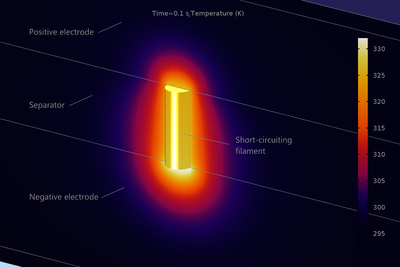
During an internal short circuit of a battery, the two electrode materials are internally and electronically interconnected, giving rise to high local current densities. Internal short circuits may occur in a lithium-ion battery due to, for instance, lithium dendrite formation or a ... En savoir plus
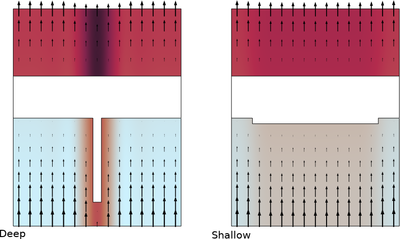
The copper current collector on negative graphite electrodes in lithium-ion batteries have been seen to dissolve at over discharge. This can be a safety concern as the dissolution damages the current collector irreversibly and dissolved copper ions can redeposit and form dendrites. ... En savoir plus
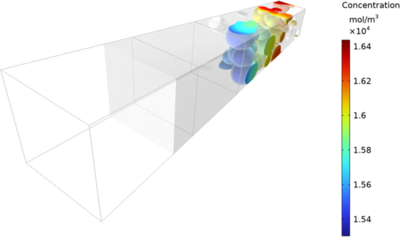
Solid-state batteries (SSB) are a promising technology that could suffer from internal mechanical stresses due to the growth and shrinkage of the electrodes within all-solid components. With this model, the charge-discharge cycling of an SSB is simulated with a focus on the interaction ... En savoir plus
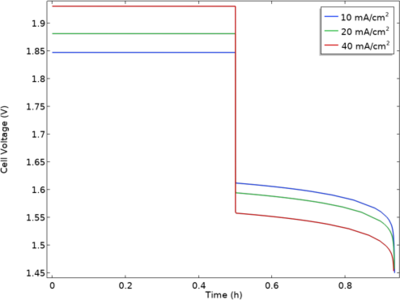
The zinc bromine redox flow battery is an electrochemical energy storage technology suitable for stationary applications. Compared to other flow battery chemistries, the Zn-Br cell potentially features lower cost, higher energy densities and better energy efficiencies. In the cell ... En savoir plus
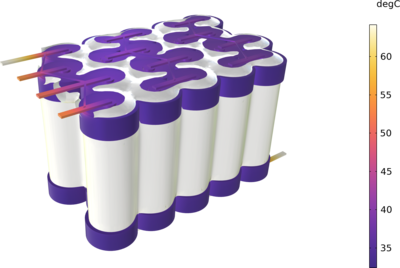
Thermal management of a battery pack is simulated considering two scenarios, air (natural convection) and phase change material (PCM) in the gap between the batteries. The PCM considered is a composite material of paraffin wax and graphite additive. Graphite is typically added for ... En savoir plus
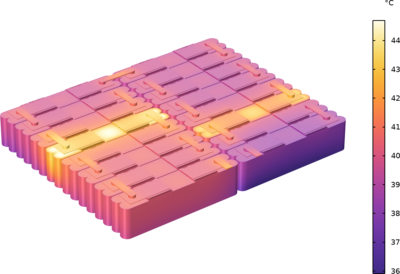
This example models the temperature profile in a liquid-cooled prismatic battery pack during a high-rate charge. The pack consists of 16 prismatic battery cells connected by busbars, placed on an aluminum plate containing four cooling channels. The battery pack is assumed to have two ... En savoir plus
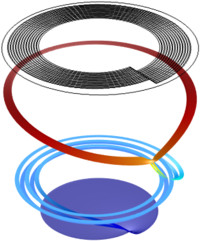
Due to the large differences in length scales in a lithium-ion battery, with the thickness of the different layers typically being several orders of magnitude smaller than the extension in the sheet direction, a lithium-ion battery is often well represented by a one-dimensional model. ... En savoir plus


