
La Bibliothèque d'Applications présente des modèles construits avec COMSOL Multiphysics pour la simulation d'une grande variété d'applications, dans les domaines de l'électromagnétisme, de la mécanique des solides, de la mécanique des fluides et de la chimie. Vous pouvez télécharger ces modèles résolus avec leur documentation détaillée, comprenant les instructions de construction pas-à-pas, et vous en servir comme point de départ de votre travail de simulation. Utilisez l'outil de recherche rapide pour trouver les modèles et applications correspondant à votre domaine d'intérêt. Notez que de nombreux exemples présentés ici sont également accessibles via la Bibliothèques d'Applications intégrée au logiciel COMSOL Multiphysics® et disponible à partir du menu Fichier.
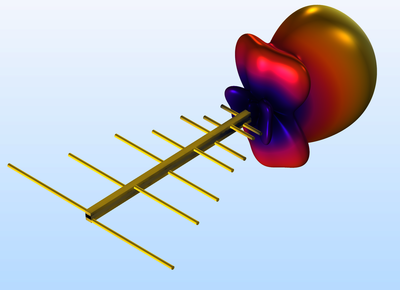
The shape of a log-periodic antenna resembles that of a Yagi-Uda antenna, but is composed of a coplanar array to achieve a wider bandwidth. It is also known as a wideband or frequency-independent antenna. All metallic parts are modeled using the perfect electric conductor (PEC) boundary ... En savoir plus
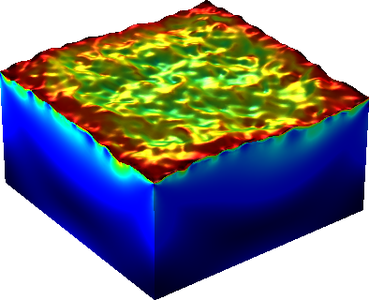
These examples demonstrate how to generate randomized geometric surfaces. Note that there is now also an add-in covering random surface functionality for planar surfaces as well as a general purpose app: "Random Surface Generator". The COMSOL Multiphysics® software provides a ... En savoir plus
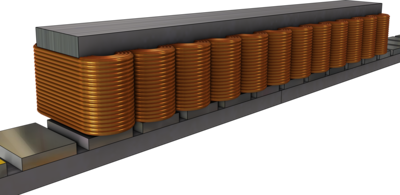
Linear motors are used in many applications in need of translational motion. Typical characteristics of linear motor designs are high precision or quick acceleration. This model investigates a synchronous motor with three-phase winding on the stationary part and permanent magnets on the ... En savoir plus
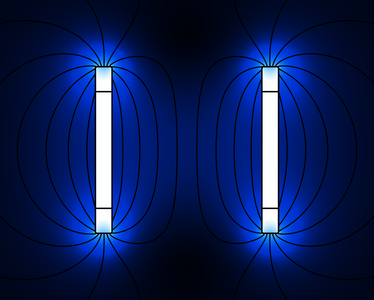
In this set of verification models and associated documentation, the accuracy of electromagnetic force calculations is investigated. Using various techniques, the total force and torque on a rigid body is determined and compared to analytical models. Using fillets, advanced meshing and ... En savoir plus
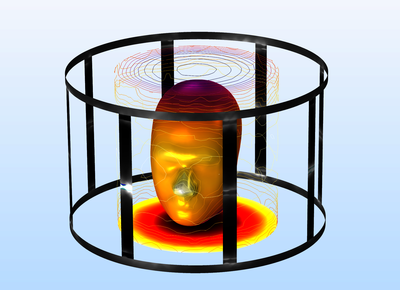
Magnetic resonance imaging (MRI) systems generate a magnetic flux density (B-field) to create images. Providing a homogeneous field distribution within a birdcage coil is a key factor for improving the quality of the scanned data. A homogeneous magnetic field can be found through ... En savoir plus
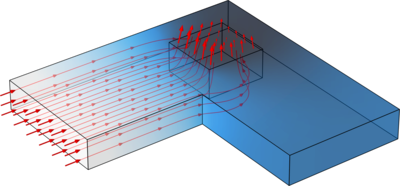
This benchmark example builds two models of a cross-bridge Kelvin resistor used for extracting the specific contact resistivity. The first model simulates the system in 3D, using the contact resistance feature built in the Semiconductor interface. The other model is a 2D approximation of ... En savoir plus
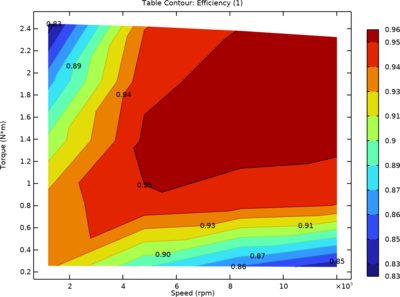
When electrical energy is converted into mechanical work in an electrical motor, the "wasted" energy that causes device heating is usually referred to as loss. The ratio of useful work to input energy, or the efficiency of the motor, is an important property for the overall energy ... En savoir plus
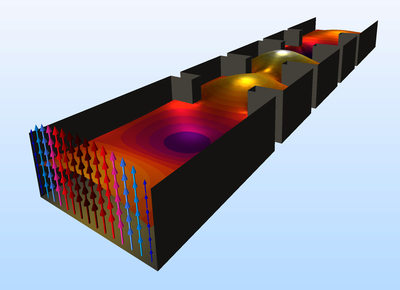
A conductive diaphragm, an iris, placed transverse to a waveguide aperture causes a discontinuity and generates shunt reactance. Bandpass frequency response can be achieved from cascaded cavity resonators combined with these reactive elements which can be created by inserting a series of ... En savoir plus


