
La Bibliothèque d'Applications présente des modèles construits avec COMSOL Multiphysics pour la simulation d'une grande variété d'applications, dans les domaines de l'électromagnétisme, de la mécanique des solides, de la mécanique des fluides et de la chimie. Vous pouvez télécharger ces modèles résolus avec leur documentation détaillée, comprenant les instructions de construction pas-à-pas, et vous en servir comme point de départ de votre travail de simulation. Utilisez l'outil de recherche rapide pour trouver les modèles et applications correspondant à votre domaine d'intérêt. Notez que de nombreux exemples présentés ici sont également accessibles via la Bibliothèques d'Applications intégrée au logiciel COMSOL Multiphysics® et disponible à partir du menu Fichier.
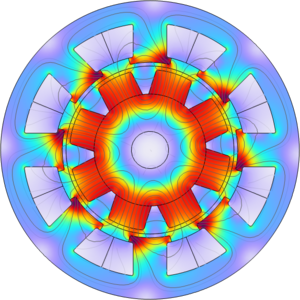
In this model, a rotor with permanent magnets and a nonlinear magnetic material rotates within a stator of the same magnetic material. The generated voltage in windings around the stator is calculated as a function of time. COMSOL Multiphysics models the rotation with assemblies and ... En savoir plus
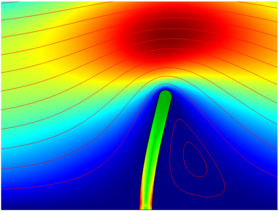
This model demonstrates how to set up a fluid-structure interaction problem in COMSOL Multiphysics. It illustrates how fluid flow can deform solid structures and how to solve for the flow in a continuously deforming geometry. The Fluid-Structure Interaction (FSI) multiphysics interface ... En savoir plus
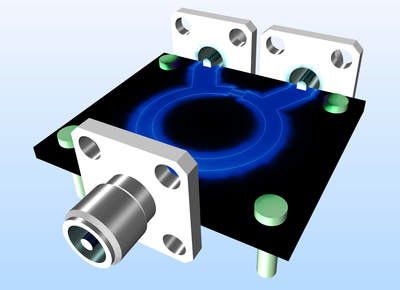
Some conventional three-port power dividers are resistive power dividers and T-junction power dividers. Such dividers are either lossy or not matched to the system reference impedance at all ports. In addition, isolation between two coupled ports is not guaranteed. The Wilkinson power ... En savoir plus
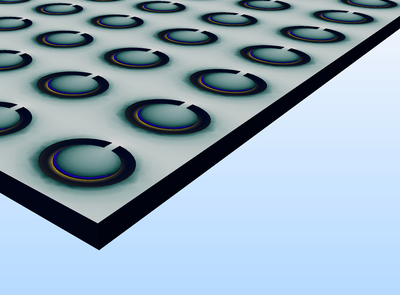
Frequency selective surfaces (FSS) are periodic structures with a bandpass or a bandstop frequency response. This model shows that only signals around the center frequency can pass through the periodic complementary split ring resonator layer. En savoir plus
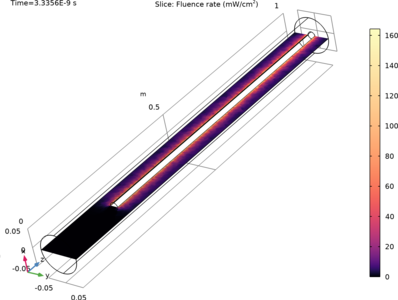
This model demonstrates how to compute the volumetric fluence rate in an ultraviolet (UV) reactor. The geometry is the annular fluid region surrounding a cylindrical lamp. The effect of reflection at the reactor walls on the radial fluence rate distribution is considered. En savoir plus
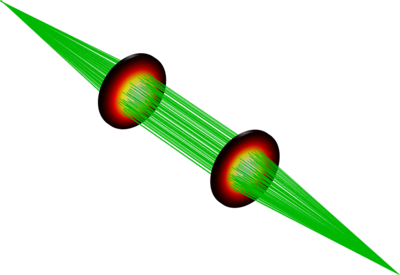
A modern high-power industrial fiber laser system can deliver up to 3kW of single-mode laser radiation on to surfaces to be cut, drilled, welded or marked. Even using highly transmissive materials, the optical component used to focus the laser beam onto target surfaces can be affected ... En savoir plus
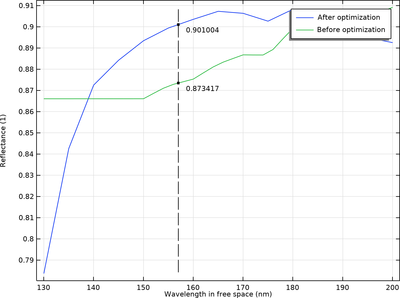
This example demonstrates how to optimize the thickness of a microelectromechanical systems (MEMS) mirror coating material for maximum reflectivity. To reduce the simulation time, a Layered Impedance Boundary Condition is used to model the thin coating material on top of the metallic ... En savoir plus
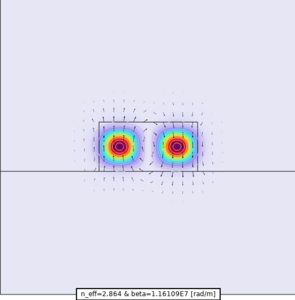
Mode analysis is a basic tool for a wide range of radio frequency and wave optics calculations because it allows for the investigation of mode characteristics in complex waveguide structures. In this tutorial model, you can find two examples that demonstrate typical settings and best ... En savoir plus


