
La Bibliothèque d'Applications présente des modèles construits avec COMSOL Multiphysics pour la simulation d'une grande variété d'applications, dans les domaines de l'électromagnétisme, de la mécanique des solides, de la mécanique des fluides et de la chimie. Vous pouvez télécharger ces modèles résolus avec leur documentation détaillée, comprenant les instructions de construction pas-à-pas, et vous en servir comme point de départ de votre travail de simulation. Utilisez l'outil de recherche rapide pour trouver les modèles et applications correspondant à votre domaine d'intérêt. Notez que de nombreux exemples présentés ici sont également accessibles via la Bibliothèques d'Applications intégrée au logiciel COMSOL Multiphysics® et disponible à partir du menu Fichier.

The thermal stress in a layered plate is studied in this example. A plate consisting of two layers, a coating and a substrate layer, is stress and strain free at 800 degrees C. The temperature of the plate is reduced to 150 degrees C and thermal stresses are induced due to the difference ... En savoir plus
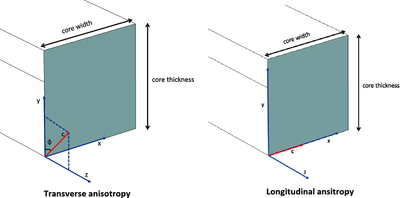
In this model, a modal analysis is performed while parametrically sweeping the length of a waveguide from 0.5 um to 4 um to derive the dispersion curve for the anisotropic core. Both transverse and longitudinal anisotropy are considered in two different models. These models are ... En savoir plus
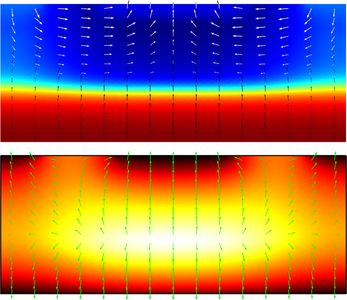
This model demonstrates how to couple the Semiconductor interface to the Heat Transfer in Solids interface. A thermal analysis is performed on the existing bipolar transistor model in the case when the device is operated in the active-forward configuration. The Semiconductor interface ... En savoir plus
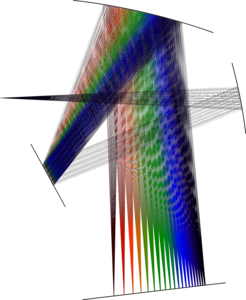
A Czerny-Turner monochromator spatially separates polychromatic light into a series of monochromatic rays. This model simulates a crossed Czerny-Turner configuration that consists of a spherical collimating mirror, a planar diffraction grating, a spherical imaging mirror, and an array ... En savoir plus
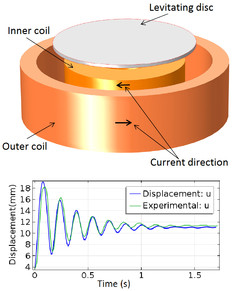
This model presents a solution to the Transient Electromagnetic Analysis Methods (TEAM) workshop problem 28, “An Electrodynamic Levitation Device”- a benchmark problem involving the dynamic coupling of electromagnetics and rigid body dynamics. An electrodynamic levitation force is ... En savoir plus
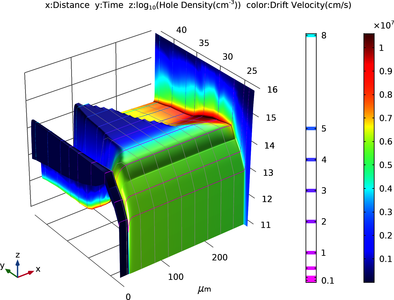
This tutorial performs steady-state and transient analysis of the response of a PIN diode to constant and pulsed radiation, respectively. The effect of radiation is modeled as spatially uniform generation of electron-hole pairs within the device. At high dose rates the separation of the ... En savoir plus
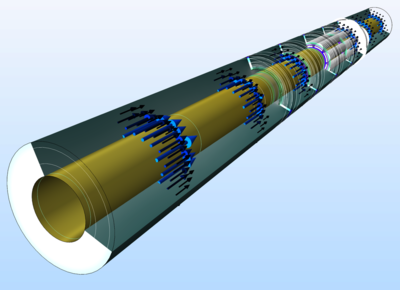
A very wide band coaxial low-pass filter is designed using a 2D axisymmetric model. To address the wide band frequency response with a fine frequency resolution, the model is built with a transient physics interface first. Then, S-parameters are calculated using a time-to-frequency ... En savoir plus
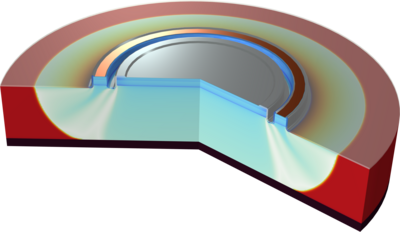
This model shows how to model the avalanche breakdown due to the impact ionization in a Silicon Carbide diode. The current-voltage (I-V) characteristics of the device are presented as well as the electric field distribution plot. Furthermore, the carrier generation term has been computed ... En savoir plus


