
La Bibliothèque d'Applications présente des modèles construits avec COMSOL Multiphysics pour la simulation d'une grande variété d'applications, dans les domaines de l'électromagnétisme, de la mécanique des solides, de la mécanique des fluides et de la chimie. Vous pouvez télécharger ces modèles résolus avec leur documentation détaillée, comprenant les instructions de construction pas-à-pas, et vous en servir comme point de départ de votre travail de simulation. Utilisez l'outil de recherche rapide pour trouver les modèles et applications correspondant à votre domaine d'intérêt. Notez que de nombreux exemples présentés ici sont également accessibles via la Bibliothèques d'Applications intégrée au logiciel COMSOL Multiphysics® et disponible à partir du menu Fichier.
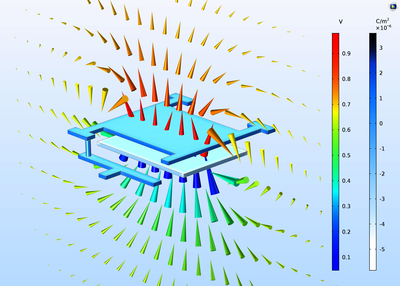
The electrostatically tunable parallel plate capacitor in this example is a typical component in various MEMS devices for radio frequencies that range between 300 MHz and 300 GHz. You can modify the distance between the two plates, as the applied voltage changes, through a spring ... En savoir plus
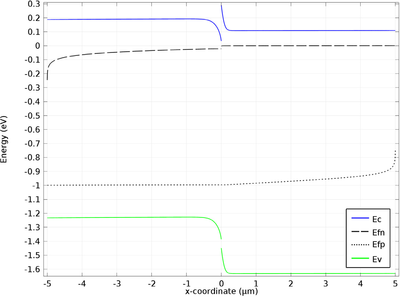
This benchmark model simulates three different heterojunction configurations under forward and reverse bias. It shows the difference in using the continuous quasi-Fermi level formulation versus the thermionic emission formulation for the charge transfer across the heterojunction. The ... En savoir plus
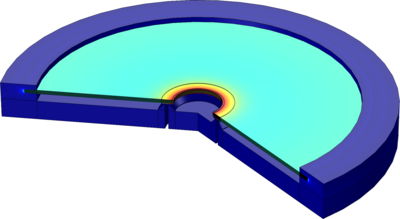
Piezoelectric valves are frequently employed in medical and laboratory applications due to their fast response times and quiet operation. Their energy efficient operation, also dissipates little heat, which is often important for these applications. This model shows how to model a ... En savoir plus
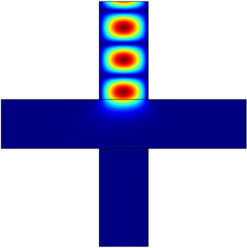
Wave heated discharges may be very simple, where a plane wave is guided into a reactor using a waveguide, or very complicated as in the case with ECR (electron cyclotron resonance) reactors. In this example, a wave is launched into reactor and an Argon plasma is created. The wave is ... En savoir plus

The mutual inductance between a primary and secondary single turn coil in a concentric coplanar arrangement is computed using a DC, steady-state, model and compared against the analytic solution. The induced currents in the secondary coil are computed using an AC, frequency-domain, ... En savoir plus
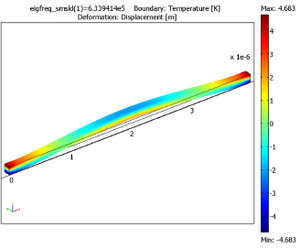
Thermoelastic damping, which arises when you subject a material to cyclic stress, is an important factor when designing MEMS resonators. The stress brings about deformation, where materials heat under compressive stress and cool under tensile stress. Thus, due to the resulting heat flux, ... En savoir plus
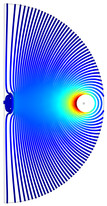
The mutual inductance and induced currents between a single turn primary and twenty turn secondary coil in a concentric coplanar arrangement is computed using a frequency domain model. The secondary coil is modeled using a homogenized approach which does not explicitly consider each turn ... En savoir plus
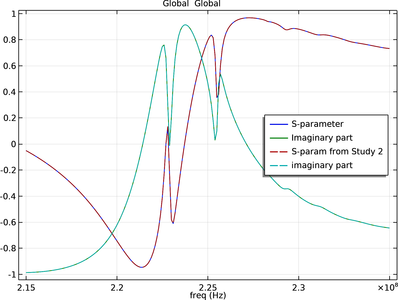
This model shows how to compute the S-parameter for a piezoelectric MEMS device by extending the tutorial Thin-Film BAW Composite Resonator. The measurement of S-parameter is commonly used to characterize such devices for RF applications. The terminal feature in the Electrostatics ... En savoir plus


