
La Bibliothèque d'Applications présente des modèles construits avec COMSOL Multiphysics pour la simulation d'une grande variété d'applications, dans les domaines de l'électromagnétisme, de la mécanique des solides, de la mécanique des fluides et de la chimie. Vous pouvez télécharger ces modèles résolus avec leur documentation détaillée, comprenant les instructions de construction pas-à-pas, et vous en servir comme point de départ de votre travail de simulation. Utilisez l'outil de recherche rapide pour trouver les modèles et applications correspondant à votre domaine d'intérêt. Notez que de nombreux exemples présentés ici sont également accessibles via la Bibliothèques d'Applications intégrée au logiciel COMSOL Multiphysics® et disponible à partir du menu Fichier.
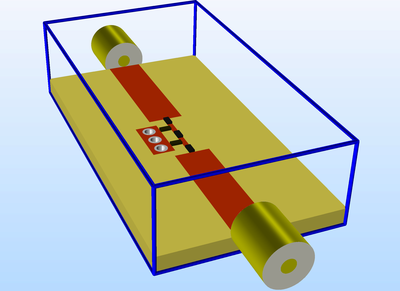
A Touchstone file describes the frequency responses of an n-port network circuit in terms of S-parameters. This can be used to simplify arbitrarily complex circuits. The Touchstone file can be obtained from numerical simulations or network analyzer measurements. The obtained file for a ... En savoir plus
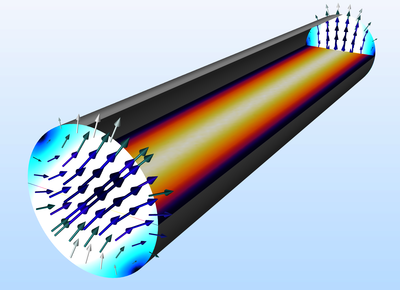
This model of a circular waveguide demonstrates how to use ports with numerical solution of the port modes. It illustrates how to align the polarization of degenerate port modes and in particular how to model and excite the TE11 mode of circular waveguides in 3D. En savoir plus
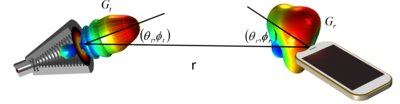
Multiscale modeling is a challenging issue in modern simulation. This occurs when there are vastly different scales in the same model. For example, your cell phone is approximately 10 cm, yet it receives GPS information from satellites 20,000 km away. In these models we examine several ... En savoir plus
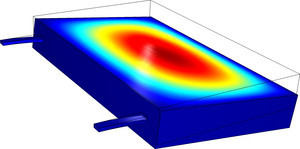
Squeezed-film gas damping is a critical aspect of many MEMS transducers and actuators. In accelerometers, for example, inertia produces a motion that the device detects. A typical structure connects a large proof mass to surrounding structures with elastic beams, which forms a mechanical ... En savoir plus
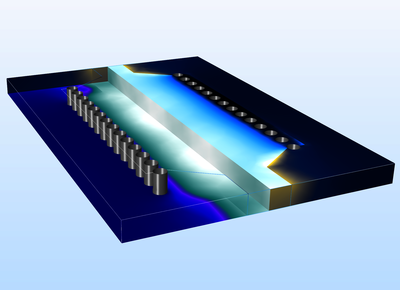
A waveguide-type structure can be fabricated on a substrate by adding vias between the microstrip line and the ground plane. Such a device will behave as a high-pass filter and is attractive because it is easy to fabricate. A model is set up that shows the S-parameters as a function of ... En savoir plus
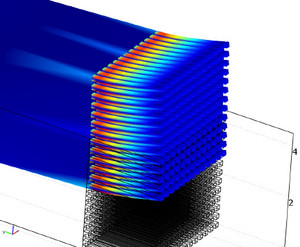
In nature, geckos use dry adhesion forces to climb walls. They have inspired researchers to develop synthetic gecko foot hairs to be used in, for example, robot applications. This model contains the nano/micro hierarchy of a synthetic gecko foot hair, where cantilever beams both in nano ... En savoir plus
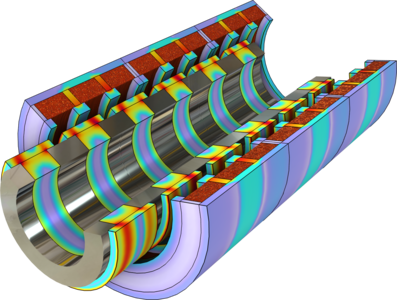
This tutorial shows how to model the tubular permanent magnet generator in 2D axisymmetry. The generator consists of a modular stationary stator and moving/oscillating slider. The stator is made of three-phase multiturn windings and an iron core. The slider is made of permanent magnets ... En savoir plus
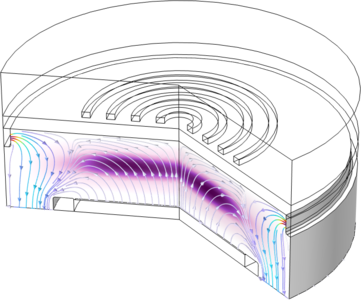
This tutorial studies the etching of silicon using an inductively coupled plasma reactor with an RF bias in a mixture of CF4/O2. The etching rate is computed along the wafer as a function of the RF bias voltage. En savoir plus


