
La Bibliothèque d'Applications présente des modèles construits avec COMSOL Multiphysics pour la simulation d'une grande variété d'applications, dans les domaines de l'électromagnétisme, de la mécanique des solides, de la mécanique des fluides et de la chimie. Vous pouvez télécharger ces modèles résolus avec leur documentation détaillée, comprenant les instructions de construction pas-à-pas, et vous en servir comme point de départ de votre travail de simulation. Utilisez l'outil de recherche rapide pour trouver les modèles et applications correspondant à votre domaine d'intérêt. Notez que de nombreux exemples présentés ici sont également accessibles via la Bibliothèques d'Applications intégrée au logiciel COMSOL Multiphysics® et disponible à partir du menu Fichier.
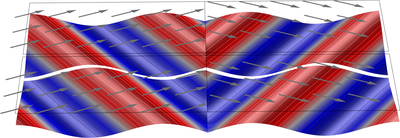
It is possible to engineer the structure of materials such that both the permittivity and permeability are negative. Such materials are realized by engineering a periodic structure with features comparable in scale to the wavelength. It is possible to model both the individual unit cells ... En savoir plus
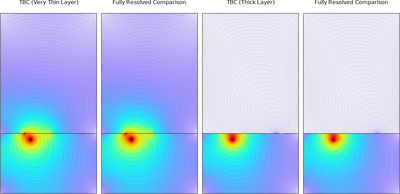
In electromagnetic simulations, such as transformers and converter stations, one often needs to include geometrically thin conductive layers. Explicitly meshing these thin layers can be computationally expensive and numerically challenging, especially when the layer thickness is much ... En savoir plus
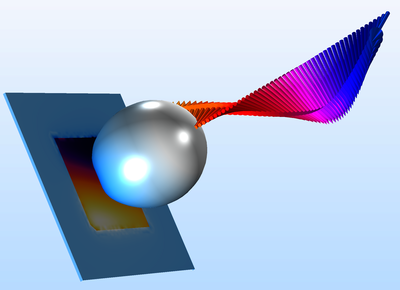
One way to generate circular polarization from a microstrip patch antenna is to truncate the patch radiator. This model is tuned around the GPS frequency range. The axial ratios are calculated to show the degree of circular polarization. En savoir plus
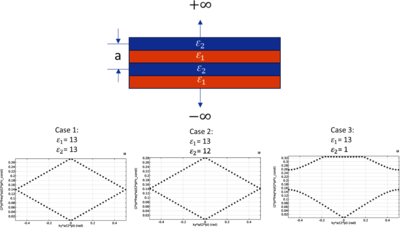
In this model, an eigenfrequency analysis is performed to give a bandgap analysis of a 1D multilayer photonic crystal extending to infinity in +/- y direction. We perform the bandgap analysis for three different cases of material properties, as discussed in Chapter 4 of Ref. 1. Case ... En savoir plus
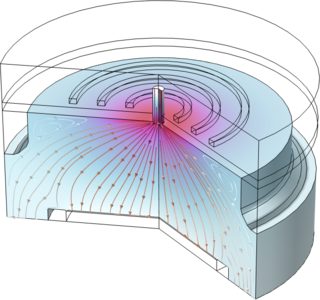
This tutorial studies the deposition of amorphous silicon using an inductively coupled plasma reactor with a silane/argon gas mixture. It examines how the deposition rate varies across the wafer as a function of silane mole fraction and input power. En savoir plus
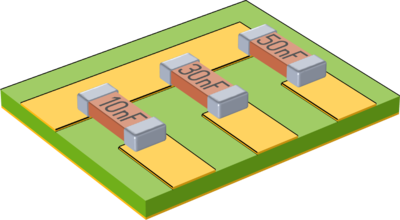
These models demonstrate the usage of the user defined lumped port and lumped elements to introduce excitations and lumped circuit elements between volumetric conductors. Additional models show how to use impedance and transition boundary conditions to model the conductors, instead of ... En savoir plus
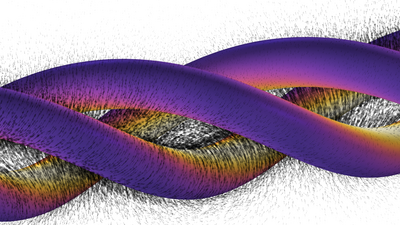
These models demonstrate various ways of exciting magnetic fields using the Magnetic Field Formulation interface in the AC/DC Module, an add-on to the COMSOL Multiphysics® software. To learn more about these models, see the accompanying blog post “Modeling of Excitations with ... En savoir plus
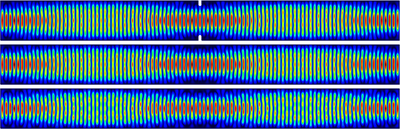
This model demonstrates three different ways to find the eigenfrequencies of a rectangular metallic cavity. The first method uses an eigenfrequency study step together with the Electromagnetic Waves, Beam Envelopes interface. Here, it is important to define a wave vector for the physics ... En savoir plus


