
La Bibliothèque d'Applications présente des modèles construits avec COMSOL Multiphysics pour la simulation d'une grande variété d'applications, dans les domaines de l'électromagnétisme, de la mécanique des solides, de la mécanique des fluides et de la chimie. Vous pouvez télécharger ces modèles résolus avec leur documentation détaillée, comprenant les instructions de construction pas-à-pas, et vous en servir comme point de départ de votre travail de simulation. Utilisez l'outil de recherche rapide pour trouver les modèles et applications correspondant à votre domaine d'intérêt. Notez que de nombreux exemples présentés ici sont également accessibles via la Bibliothèques d'Applications intégrée au logiciel COMSOL Multiphysics® et disponible à partir du menu Fichier.
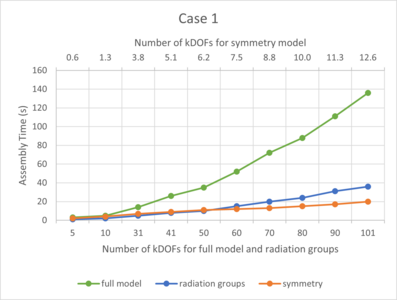
This model shows how to use the features of the Heat Transfer Module to reduce the computation time and memory usage in view factor computations. Illustrative results of speedup and memory usage reduction are given on a benchmark model. The solution is not computed, only the view ... En savoir plus
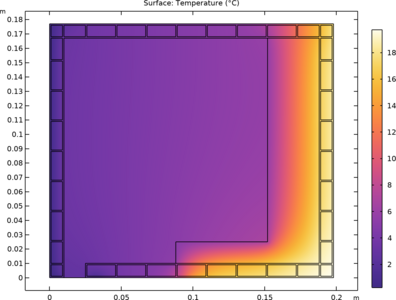
During the design of a building, environmental issues have gained considerable influence in the entire project. One of the first concerns is to improve thermal performances. In this process, simulation software are key tools to model thermal losses and performances in the building. The ... En savoir plus
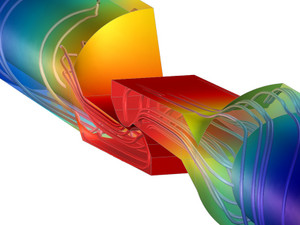
This model illustrates how to implement a multiphysics contact. It models the thermal and electrical behavior of two contacting parts of a switch. The electrical current and the heat flow from one part to the other only through the contact surface. The contact switch device has a ... En savoir plus
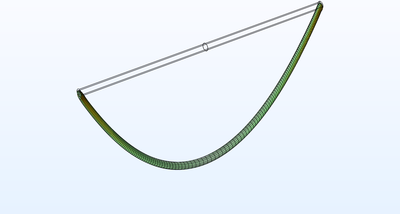
The catenary is the geometrical shape that corresponds to the curve followed by an idealized chain or cable supported at both ends and hanging under its own weight. The viscous catenary problem describes the motion of a cylinder of highly viscous fluid, supported at its ends as it flows ... En savoir plus
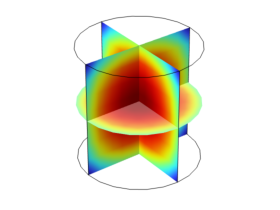
These models use the Discrete Ordinates method (DOM) and P1 approximation to solve a 3D radiative transfer problem in an emitting, absorbing, and linear-anisotropic scattering finite cylindrical medium. Using the S6 quadrature of DOM leads to accurate results, which are needed in ... En savoir plus

In this time-dependent model, a silica block of glass, coated with a thin copper layer is subjected to a heat flux. Copper is a highly conductive material, while the silica glass is of poor thermal conductivity, which sets up an highly-varied temperature differential. The model must ... En savoir plus
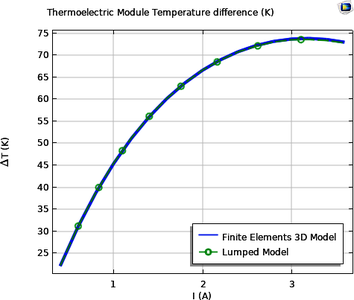
Thermoelectric coolers are widely used for electronics cooling in various application areas, ranging from consumer products to spacecraft design. The thermoelectric modules are a common application of thermoelectricity in cooling engineering. They consist of several thermoelectric legs ... En savoir plus
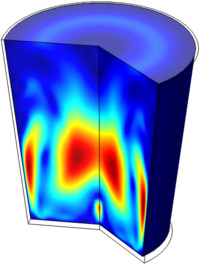
This model treats the free convection and heat transfer of a glass of cold water heated to room temperature. Initially, the glass and the water are at 5 °C and are then put on a table in a room at 25 °C. The nonisothermal flow is coupled to heat transfer using the Heat Transfer module. En savoir plus
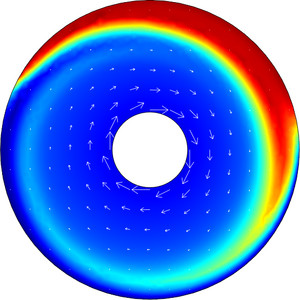
Liquid-solid mixtures (suspensions) are important in a variety of industrial fields, such as oil and gas refinement, paper manufacturing, food processing, slurry transport, and wastewater treatment. Several different modeling approaches have been developed by the CFD community, ranging ... En savoir plus
The contact angle of a two-fluid interface with a solid surface is determined by the balance of the forces at the contact point. In electrowetting the balance of forces at the contact point is modified by the application of a voltage between a conducting fluid and the solid surface. In ... En savoir plus


