
La Bibliothèque d'Applications présente des modèles construits avec COMSOL Multiphysics pour la simulation d'une grande variété d'applications, dans les domaines de l'électromagnétisme, de la mécanique des solides, de la mécanique des fluides et de la chimie. Vous pouvez télécharger ces modèles résolus avec leur documentation détaillée, comprenant les instructions de construction pas-à-pas, et vous en servir comme point de départ de votre travail de simulation. Utilisez l'outil de recherche rapide pour trouver les modèles et applications correspondant à votre domaine d'intérêt. Notez que de nombreux exemples présentés ici sont également accessibles via la Bibliothèques d'Applications intégrée au logiciel COMSOL Multiphysics® et disponible à partir du menu Fichier.
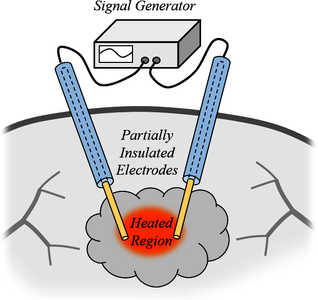
This example shows how to model tissue ablation through applying RF radiation. A more detailed description of the phenomenon and the modeling process can be seen in the blog post "Study Radio Frequency Tissue Ablation Using Simulation". En savoir plus
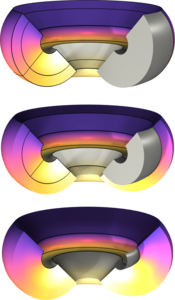
This tutorial model demonstrates the use of the features for heat transfer in layered shells, to account for the curvature of the layers when applying heat fluxes and heat sources. The results obtained with the Heat Transfer in Shells interface applied to a boundary (with extra ... En savoir plus
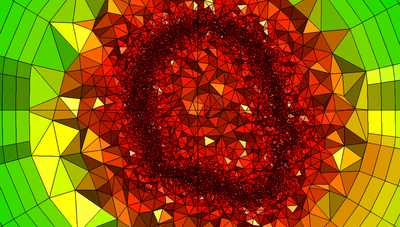
Creating irregular geometries can be a good solution, even the only option, for some types of applications. These files present a way to use a text file with material properties defined in coordinates to assign different materials even though there is only one regular domain. The same ... En savoir plus

To understand the risk of coagulation and blood clot formation in an abdominal aortic aneurysm (AAA), modeling and simulation can be used to study the blood flow through the AAA. In this example, blood is modeled as an Oldroyd-B fluid. While this is a generic example, if instead using ... En savoir plus
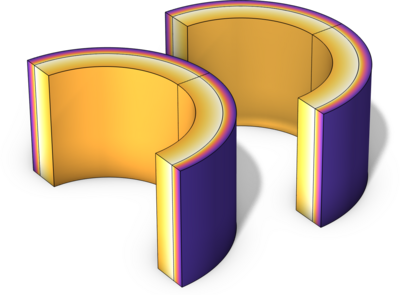
This tutorial model demonstrates the use of the Area Scaling Factor (ASF) in the Heat Transfer in Shells interface, to account for the curvature of the layers when applying heat fluxes and heat sources. The results obtained with the Heat Transfer in Shells interface applied to a ... En savoir plus
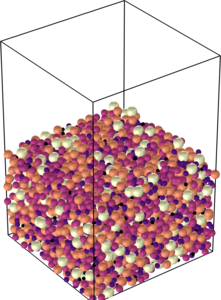
In this model, the packing behavior of grains is simulated using three force models: Hertz-MD, Hertz-MD with adhesion, Hertz-MD with adhesion and van der Waals forces. The packing efficiency is calculated to quantify the extent of packing observed. En savoir plus

Rayleigh-Bénard's convection cells is a classic in fluid dynamics. We present here two different approaches for computing the critical Rayleigh number above which the cells form. En savoir plus
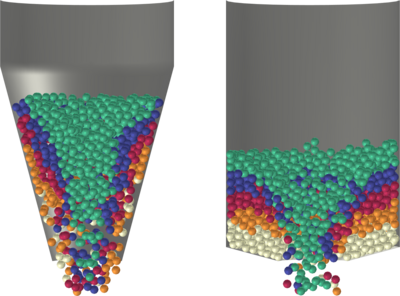
This model demonstrates the effect of the hopper design on the resulting flow patterns of the grains exiting the hopper. The flow changes from mass flow to funnel flow when the conical angle of the hopper is increased. En savoir plus
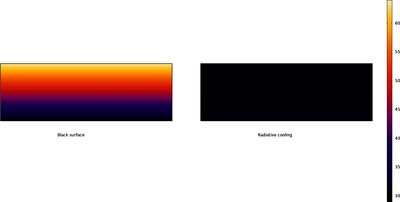
Because the atmosphere is nearly transparent to wavelengths in the range 8 to 13 µm (atmospheric window) for a clear sky, it is possible to cool down a surface even during a sunny day. This model compares the temperature distribution on a concrete block exposed to ambient and solar ... En savoir plus
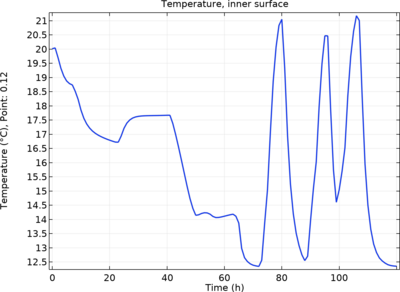
This tutorial shows how to simulate coupled heat and moisture transport in a wall made of a load bearing and an insulation layer. Moisture and temperature conditions vary with time on both sides of the wall and rain loading is included. The 1D model is a benchmark test defined in ... En savoir plus


