
La Bibliothèque d'Applications présente des modèles construits avec COMSOL Multiphysics pour la simulation d'une grande variété d'applications, dans les domaines de l'électromagnétisme, de la mécanique des solides, de la mécanique des fluides et de la chimie. Vous pouvez télécharger ces modèles résolus avec leur documentation détaillée, comprenant les instructions de construction pas-à-pas, et vous en servir comme point de départ de votre travail de simulation. Utilisez l'outil de recherche rapide pour trouver les modèles et applications correspondant à votre domaine d'intérêt. Notez que de nombreux exemples présentés ici sont également accessibles via la Bibliothèques d'Applications intégrée au logiciel COMSOL Multiphysics® et disponible à partir du menu Fichier.
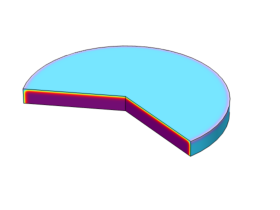
When cooking food, such as a patty, in convection ovens there is a trade off in the heating method. If the patty is heated at a low oven temperature the cooking is slow and the patty dries out, resulting in a poor taste. If the patty is heated rapidly at a high temperature, it is ... En savoir plus
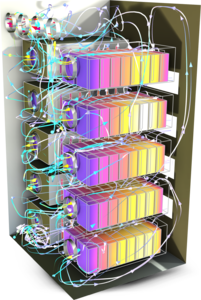
Tutorial model of an air-cooled battery energy storage system (BESS). The model includes conjugate heat transfer with turbulent flow, fan curves, internal screens, and grilles. It features several interesting aspects: Fully parameterized geometry, which can be modified for different ... En savoir plus
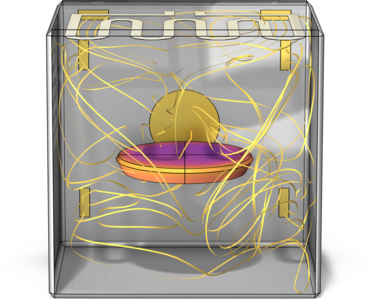
This example models the heating inside an oven with the Single Phase Flow, Heat Transfer and Surface-to-Surface Radiation interfaces. It accounts for conductive, convective and radiative heat transfer. Two computation approaches are set up: A one-way nonisothermal flow (one-way NITF) ... En savoir plus
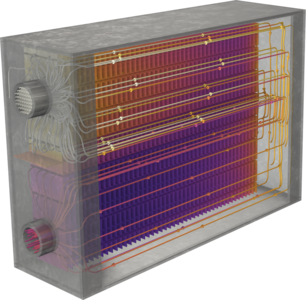
This tutorial model shows how a plate-fin heat exchanger made of aluminum is used to cool down hot oil with colder air. In order to maximize heat transfer, the heat exchanger is made of a porous aluminum matrix in which the hot oil flows. Heat is conducted through aluminum fins in ... En savoir plus
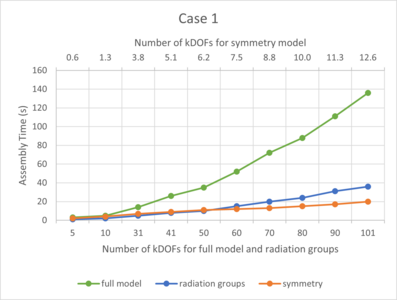
This model shows how to use the features of the Heat Transfer Module to reduce the computation time and memory usage in view factor computations. Illustrative results of speedup and memory usage reduction are given on a benchmark model. The solution is not computed, only the view ... En savoir plus
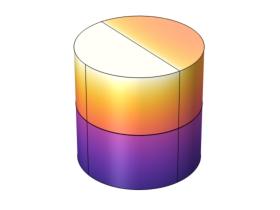
This example shows how to set up multiple sandwiched thin layers with different thermal conductivities in two different ways. First, the composite is modeled as a 3D object. In the second approach, the thin domains are modeled with thermal resistors in the Lumped Thermal System ... En savoir plus
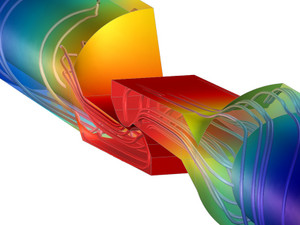
This model illustrates how to implement a multiphysics contact. It models the thermal and electrical behavior of two contacting parts of a switch. The electrical current and the heat flow from one part to the other only through the contact surface. The contact switch device has a ... En savoir plus
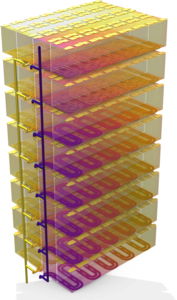
High-power battery energy storage systems (BESS) are often equipped with liquid-cooling systems to remove the heat generated by the batteries during operation. This tutorial demonstrates how to define and solve a high-fidelity model of a liquid-cooled BESS pack which consists of 8 ... En savoir plus
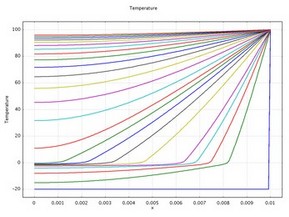
This example demonstrates how to model a phase change and predict its impact on a heat transfer analysis. When a material changes phase, for instance from solid to liquid, energy is added to the solid. Instead of creating a temperature rise, the energy alters the material’s molecular ... En savoir plus
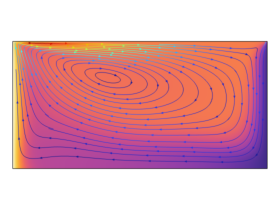
Marangoni convection occurs when the surface tension of an interface (generally liquid-air) depends on the concentration of a species or on the temperature distribution. In the case of temperature dependence, the Marangoni effect is also called thermo-capillary convection. The Marangoni ... En savoir plus


