
La Bibliothèque d'Applications présente des modèles construits avec COMSOL Multiphysics pour la simulation d'une grande variété d'applications, dans les domaines de l'électromagnétisme, de la mécanique des solides, de la mécanique des fluides et de la chimie. Vous pouvez télécharger ces modèles résolus avec leur documentation détaillée, comprenant les instructions de construction pas-à-pas, et vous en servir comme point de départ de votre travail de simulation. Utilisez l'outil de recherche rapide pour trouver les modèles et applications correspondant à votre domaine d'intérêt. Notez que de nombreux exemples présentés ici sont également accessibles via la Bibliothèques d'Applications intégrée au logiciel COMSOL Multiphysics® et disponible à partir du menu Fichier.
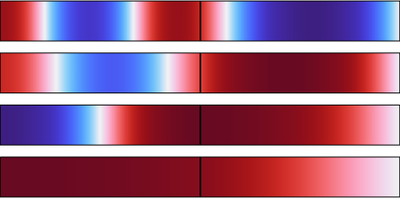
This tutorial demonstrates how to model the interaction between an acoustic field and the heat release from a flame, using the Flame Model domain feature. Modeling this interaction is important in order to understand and predict unstable acoustic modes in gas turbines and jet engines. ... En savoir plus
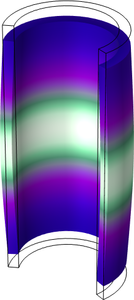
This model calculates the eigenfrequencies and mode shapes of an unconstrained cylinder in axisymmetry. The model is taken from NAFEMS Free Vibration Benchmarks. The eigenfrequencies are compared with the values given in the benchmark report. Three different physics interfaces are ... En savoir plus
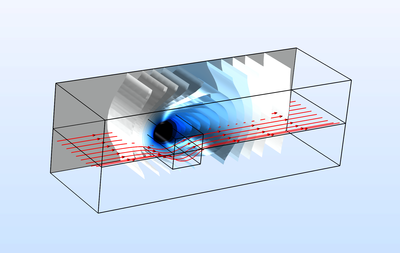
This example is a benchmark problem for simulating phase change in porous media. It studies the melting process of an ice inclusion within porous media and therefore demonstrates how to couple Darcy's Law with the Heat Transfer in Porous Media interface including phase change. En savoir plus
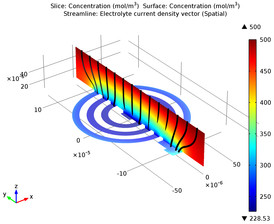
This example models the deposition of an inductor coil in 3D. The geometry includes the extrusion of the deposition pattern into an isolating photoresist mask, and a diffusion layer on top of the photoresist. The mass transfer of copper ions in the electrolyte has a major impact on the ... En savoir plus
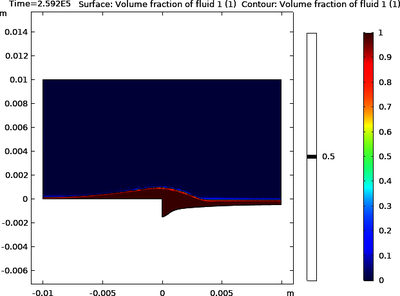
In this model, the effect of corrosion product on galvanic corrosion between a magnesium alloy (AE44) and mild steel in contact with brine solution is presented, wherein deformed boundaries due to both deposition of corrosion product as well as dissolution of magnesium are considered. ... En savoir plus

Wastewater treatment is a several-step process for removing contaminants. Firstly, large, solid particles are removed through sedimentation, flotation, and filtration. And then in a second step, biological treatment causes the smaller particles to aggregate, forming so called flocs. ... En savoir plus

In this tutorial, the eigenmodes and eigenfrequencies of an air bubble in water is modeled and compared with analytical solutions. The effects of surface tension is included and allows to model both the pulsating mode and the surface modes of the bubble. Lastly, the effect of the ... En savoir plus
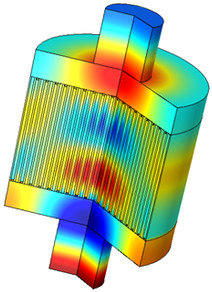
This is the model of the acoustics in a particulate-filter-like system. Real systems, like diesel particulate filters (DPFs), are designed to remove/filter soot (diesel particles) from the exhaust of diesel engine vehicles. The porous medium in such systems are typically structured with ... En savoir plus
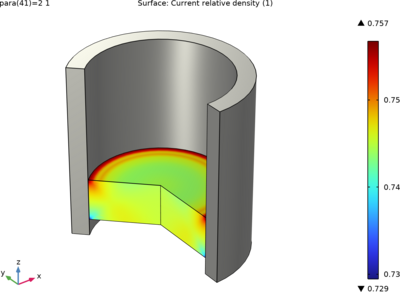
Powder compaction is a popular manufacturing process not only in powder metallurgy, but also in the pharmaceutical industry. The Capped Drucker–Prager model is commonly used for simulating the compaction processes of pharmaceutical powders, where the material properties depend on the ... En savoir plus

The powder compaction process is becoming common in the manufacturing industry, thanks to its potential to produce components of complex shape and high strength. In this example, the compaction of iron powder to form an axisymmetric rotational flanged component is analyzed with capped ... En savoir plus


