
La Bibliothèque d'Applications présente des modèles construits avec COMSOL Multiphysics pour la simulation d'une grande variété d'applications, dans les domaines de l'électromagnétisme, de la mécanique des solides, de la mécanique des fluides et de la chimie. Vous pouvez télécharger ces modèles résolus avec leur documentation détaillée, comprenant les instructions de construction pas-à-pas, et vous en servir comme point de départ de votre travail de simulation. Utilisez l'outil de recherche rapide pour trouver les modèles et applications correspondant à votre domaine d'intérêt. Notez que de nombreux exemples présentés ici sont également accessibles via la Bibliothèques d'Applications intégrée au logiciel COMSOL Multiphysics® et disponible à partir du menu Fichier.
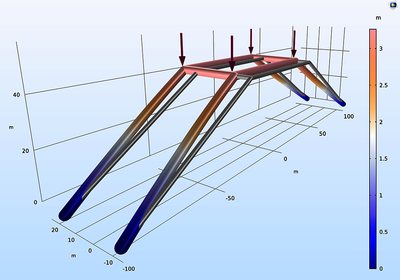
This model illustrates the instability of a space arc frame under concentrated vertical loading. The Beam interface is utilized. Two different approaches are used: A full incremental nonlinear analysis, where a small lateral load is applied to break the symmetry of the structure A ... En savoir plus

In many structural dynamics applications, some components are stiff compared to the supporting structure. Such a stiff part will only contribute to the dynamic properties of the structure through its mass and moment of inertia. It is then possible to reduce the model size significantly ... En savoir plus
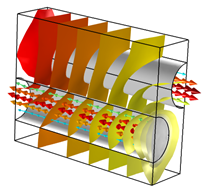
The example concerns a stainless-steel MEMS heat exchanger, which you can find in lab-on-a-chip devices in biotechnology and in microreactors such as for micro fuel cells. This model examines the heat exchanger in 3D, and it involves heat transfer through both convection and ... En savoir plus
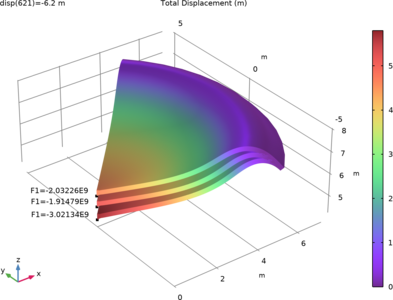
This benchmark studies the nonlinear deformation of a spherical cap subjected to point load at center using 2D axisymmetric Solid Mechanics and Shell interfaces. The results from the Shell interface are compared with Solid Mechanics interface as well as with analytical results given in ... En savoir plus
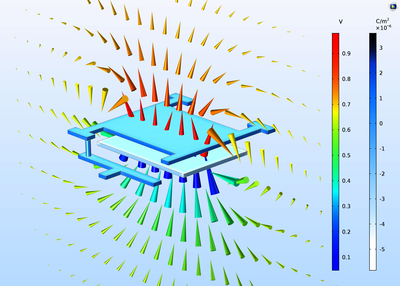
The electrostatically tunable parallel plate capacitor in this example is a typical component in various MEMS devices for radio frequencies that range between 300 MHz and 300 GHz. You can modify the distance between the two plates, as the applied voltage changes, through a spring ... En savoir plus
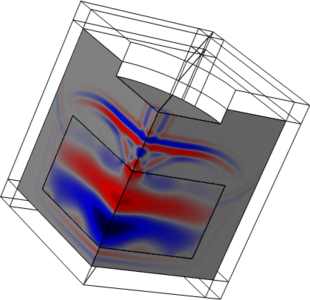
This tutorial showcases the principles of the immersion ultrasonic testing technique. A search unit placed in a water tank sends an ultrasonic pulse signal that scatters off a solid object. Part of the signal is reflected back to the search unit by the object and possible flaws in it. By ... En savoir plus

In this model, a turbocharger supported on two floating ring bearings is studied. The film forces on the ring cause it to rotate within the bearing. In steady state, the ring rotates at a constant angular speed and the torque on the ring due to the inner and outer films are balanced. ... En savoir plus

The eigenfrequencies of a rotating blade are studied in this benchmark. It shows how stress stiffening and spin softening affect the fundamental eigenfrequency. High rotational speeds in rotating machinery can result in centrifugal forces of considerable magnitude. The forces induced by ... En savoir plus
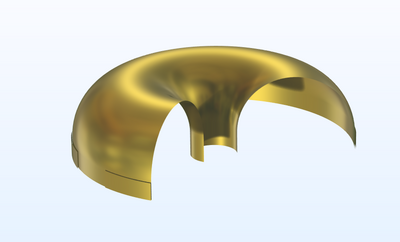
This tutorial demonstrates how to model a gyroscope based on the birdbath resonator gyroscope (BRG) design. The BRG is a type of Coriolis vibratory gyroscope (CVG) invented at the University of Michigan as a navigation-grade gyroscope in the mm-scale. This tutorial shows how the ... En savoir plus
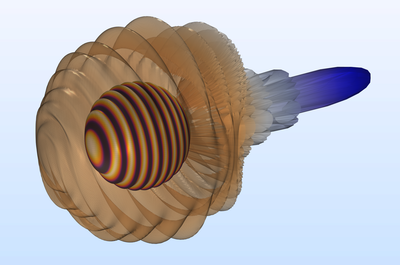
This example uses asymptotic techniques to study the radar cross-section (RCS) response of a conductive sphere. The selected physics interface transforms the incident plane-wave field on the boundaries to the far-field using the Stratton–Chu formula. The computed results are compared to ... En savoir plus


