
La Bibliothèque d'Applications présente des modèles construits avec COMSOL Multiphysics pour la simulation d'une grande variété d'applications, dans les domaines de l'électromagnétisme, de la mécanique des solides, de la mécanique des fluides et de la chimie. Vous pouvez télécharger ces modèles résolus avec leur documentation détaillée, comprenant les instructions de construction pas-à-pas, et vous en servir comme point de départ de votre travail de simulation. Utilisez l'outil de recherche rapide pour trouver les modèles et applications correspondant à votre domaine d'intérêt. Notez que de nombreux exemples présentés ici sont également accessibles via la Bibliothèques d'Applications intégrée au logiciel COMSOL Multiphysics® et disponible à partir du menu Fichier.
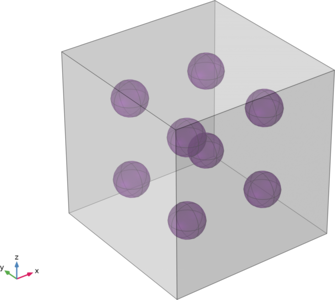
In this example, the homogenized elastic and viscoelastic properties of a particulate composite are computed based on the individual properties of elastic particles embedded in a viscoelastic matrix. Periodic boundary conditions are applied to a unit cell of the particulate composite ... En savoir plus
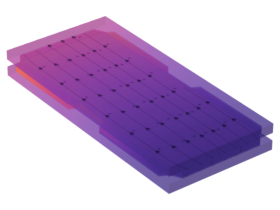
This tutorial models the thermal management of a polymer electrolyte membrane (PEM) fuel cell stack. Operating the stack with a similar temperature profile for all cells is important since an uneven temperature distribution may otherwise result in nonuniform water vapor condensation and ... En savoir plus
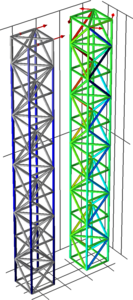
Sensitivity analysis is an efficient way of computing the gradient of an objective function with respect to many control variables. This example uses the pitch and yaw in the top of a truss tower as objective functions. It shows how to compute the sensitivity of these angles with respect ... En savoir plus
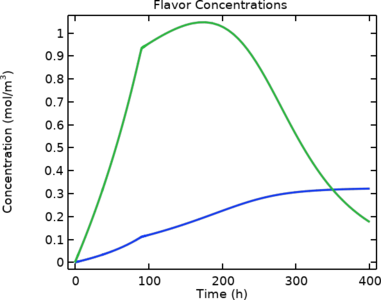
An important step in brewing beer is the fermentation process. Here, alcohol is formed together with various flavor substances from sugars in the presence of yeast. The initial sugar content, temperature, and yeast type dictate how the fermentation proceeds. In this example, the ... En savoir plus
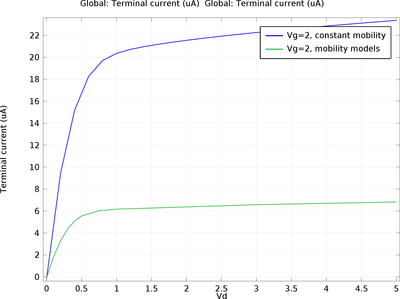
This model shows how to add several linked mobility models to the simple MOSFET example. En savoir plus
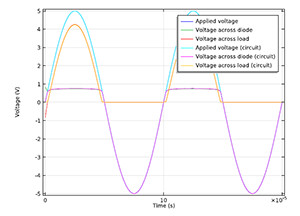
This model extracts spice parameters for a silicon p-n junction diode. The spice parameters are used to create a lumped-element equivalent circuit model of a half-wave rectifier that is compared to a full device level simulation. In this example, a device model is made by connecting a 2D ... En savoir plus
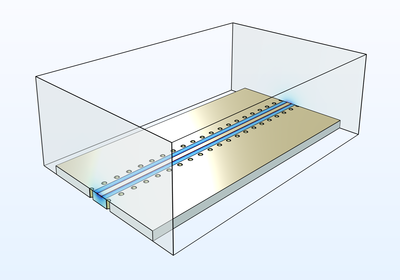
This tutorial example shows how to set port features in a physics interface when designing a grounded coplanar waveguide (GCPW) circuit that is useful for mmWave applications. En savoir plus
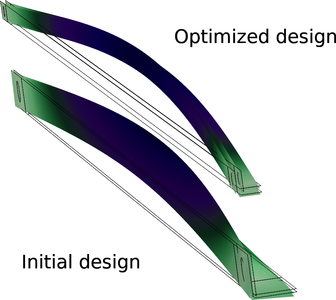
Buckling is a common failure mode for slender structural components. This model shows how the buckling load of a diagonal brace can be maximized, while constraining the volume of the brace. En savoir plus
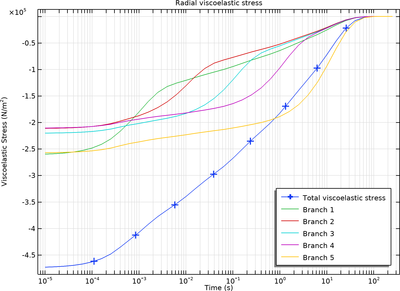
Anisotropic hyperelastic materials are used for modeling collagenous soft tissue in arterial walls. The Arterial Wall Mechanics application describes a section of an artery based on the Holzapfel–Gasser-Ogden hyperelastic material model. In this example the dynamic behavior of the artery ... En savoir plus
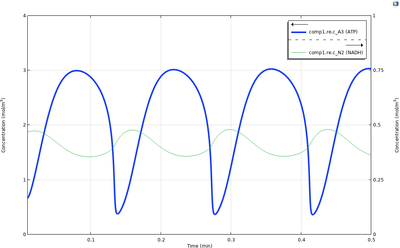
Oscillating chemical reactions were long thought to simply not exist in homogeneous solution, and even the poster child, the Belousov–Zhabotinsky reaction, met such an initial skepticism, that even though it was discovered in 1951, it took almost 20 years for it to gain widespread fame. ... En savoir plus


