
La Bibliothèque d'Applications présente des modèles construits avec COMSOL Multiphysics pour la simulation d'une grande variété d'applications, dans les domaines de l'électromagnétisme, de la mécanique des solides, de la mécanique des fluides et de la chimie. Vous pouvez télécharger ces modèles résolus avec leur documentation détaillée, comprenant les instructions de construction pas-à-pas, et vous en servir comme point de départ de votre travail de simulation. Utilisez l'outil de recherche rapide pour trouver les modèles et applications correspondant à votre domaine d'intérêt. Notez que de nombreux exemples présentés ici sont également accessibles via la Bibliothèques d'Applications intégrée au logiciel COMSOL Multiphysics® et disponible à partir du menu Fichier.
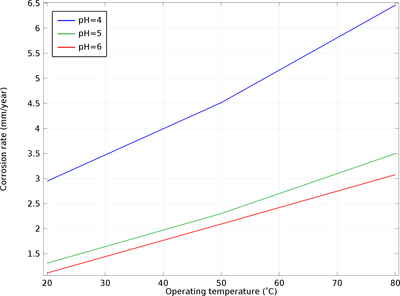
Carbon dioxide in aqueous solution is highly corrosive and can cause significant damage to steel designs. Such conditions arise in pipes used in a variety of applications, especially within the petrochemical industry. In this tutorial example, turbulent flows consisting of carbon ... En savoir plus
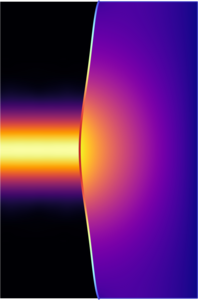
The thermal effects of a laser beam incident on a Semiconductor Saturable Absorber Mirror (SESAM) are simulated under a range of incident beam powers. This is done in two steps. The first study simulates the multiphysics combination of the saturated absorption of the beam on a SESAM, ... En savoir plus

This tutorial model demonstrates how to use the Combined Inductively/DC Discharge interface to simulate the plasma generated in a pulsed arc. This modeling technique is useful for a large range of industrial applications including cutting, welding, spraying, waste destruction, and ... En savoir plus
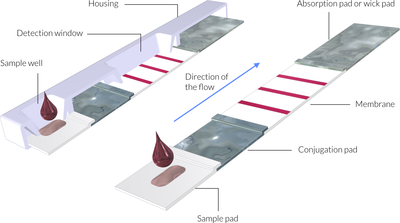
This example introduces three different models for a lateral flow assay for the detection of coronavirus antibodies. These models are as follows: 3D model for studying possible symmetries in the spreading of the liquid sample in the test strip. The 3D model shows that the flow is ... En savoir plus
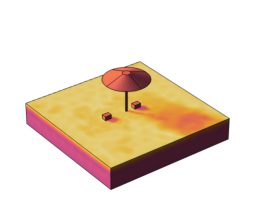
This tutorial model illustrates how to analyze the thermal effects of the sun as an external radiative source and considers wavelength-dependent surface emissivities. Specifically, the model features two coolers containing beverage cans that are exposed to ambient conditions and a beach ... En savoir plus
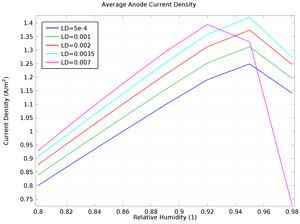
This model simulates atmospheric galvanic corrosion of an aluminum alloy in contact with steel. The electrolyte film thickness depends on the relative humidity of the surrounding air and the salt load density of NaCl crystals on the metal surface. Empirical expressions for the oxygen ... En savoir plus
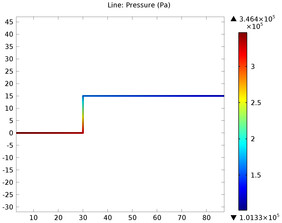
This tutorial model illustrates how to calculate the pressure drop and initial flow rate in a pipe system connected to water tank. The Pipe Flow interface contains ready to use friction models accounting for the surface roughness of pipes as well as pressure losses in bends and valves. En savoir plus

This example illustrates the principle of electrochemical polishing. The simplified 2D model geometry consists of two electrodes and an intermediate electrolyte domain The positive electrode has a protrusion, representing a surface defect. The purpose of the model is to examine how this ... En savoir plus
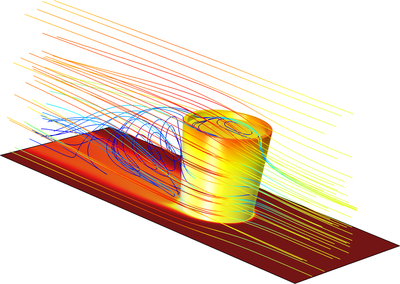
This tutorial shows how to couple three physics interfaces to model evaporative cooling. The effects that need to be taken into account are heat transfer, transport of water vapor, and fluid flow. The Wet Surface feature is used to implement the source term for the water vapor and to ... En savoir plus
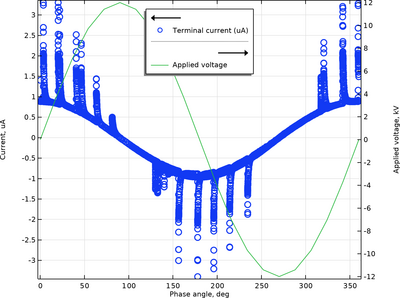
The electrical insulation strength of gases is generally much lower than that of solids. Under normal operating conditions, electrical discharges—known as partial discharges—can occur in voids or cracks within a solid dielectric. This model simulates partial discharges in a spherical ... En savoir plus