
La Bibliothèque d'Applications présente des modèles construits avec COMSOL Multiphysics pour la simulation d'une grande variété d'applications, dans les domaines de l'électromagnétisme, de la mécanique des solides, de la mécanique des fluides et de la chimie. Vous pouvez télécharger ces modèles résolus avec leur documentation détaillée, comprenant les instructions de construction pas-à-pas, et vous en servir comme point de départ de votre travail de simulation. Utilisez l'outil de recherche rapide pour trouver les modèles et applications correspondant à votre domaine d'intérêt. Notez que de nombreux exemples présentés ici sont également accessibles via la Bibliothèques d'Applications intégrée au logiciel COMSOL Multiphysics® et disponible à partir du menu Fichier.
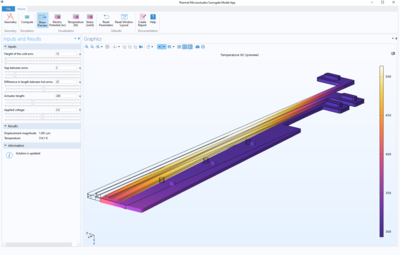
The Thermal Actuator Surrogate Model Application demonstrates how the computational speed can be increased with the use of a surrogate model. This app demonstrates the following: Adjusting input parameters via sliders, with near-instantaneous updates to the solution retrieved from the ... En savoir plus
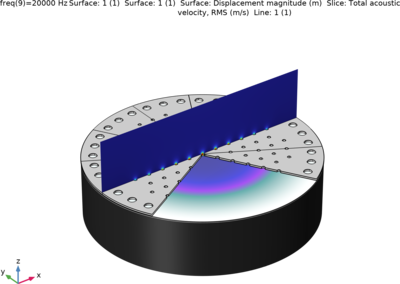
This is a model of a MEMS microphone solved in the frequency domain including the DC prestress effects. The model is set up using the Electromechanics multiphysics interface, Thermoviscous Acoustics, and Pressure Acoustics. The microphone consists of a perforated plate and a prestressed ... En savoir plus
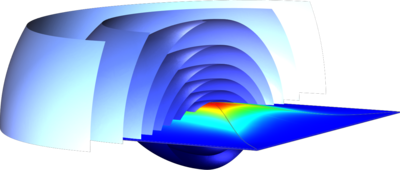
This model analyzes a piezoelectric microelectromechanical system (MEMS) speaker. The speaker, composed of four triangular membranes, uses a layer of lead zirconate titanate (PZT) material with two electrodes on top of a silicon layer as actuators. The triangular membranes are separated ... En savoir plus

A plane-wave mode feeds an axisymmetric horn radiating from an infinite baffle toward an open half space. The radius of the waveguide attached to the horn throat is assumed to be fixed, as well as the depth of the horn and the size of the horn mouth attached to the baffle. By varying the ... En savoir plus
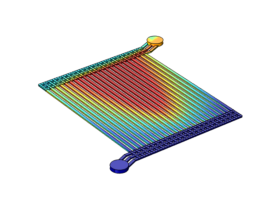
In a polymer electrolyte membrane electrolyzer cell (PEMEC), the two electrode compartments are separated by a polymer membrane. Liquid water is fed to the anode side, forming oxygen gas on the anode, and hydrogen gas on the cathode side, respectively. The respective designs of the ... En savoir plus
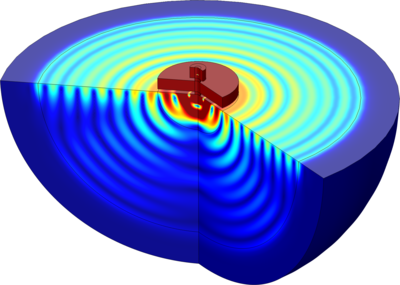
This model shows how to compute the anchor loss limited quality factor of a diamond disc resonator. The resonator is anchored to the substrate by a polysilicon post and power is transmitted to the substrate through the post. A perfectly matched layer is used to represent the essentially ... En savoir plus
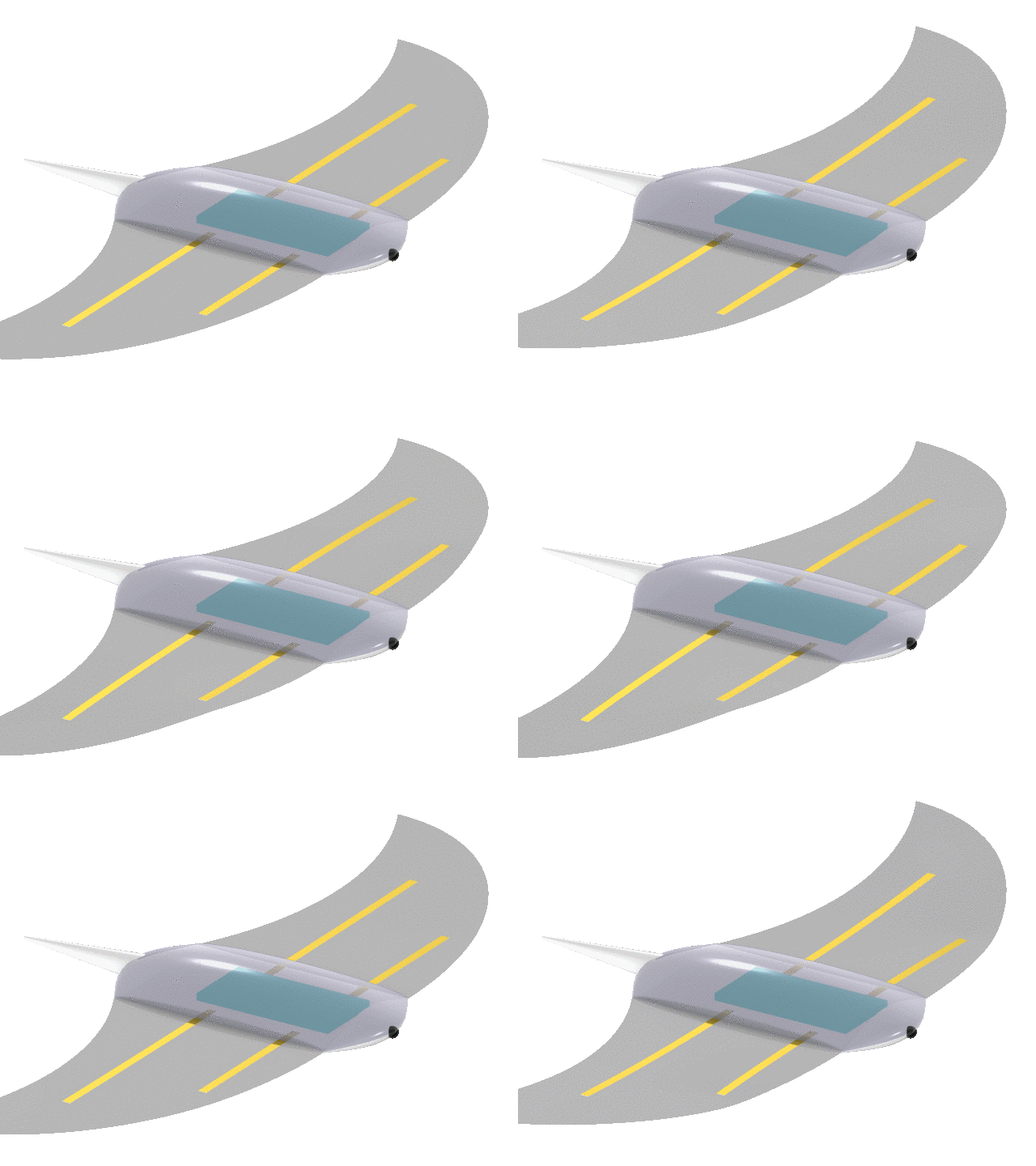
This example shows how to set up an ionic polymer-metal composite (IPMC) as an actuator for a robotic manta ray. Two IPCM beams are integrated into the fin and can be controlled independently. The chemomechanical effect is achieved with the Shrinkage and Swelling multiphysics ... En savoir plus

This example is inspired by a classic bridge type called a Pratt truss bridge. You can identify a Pratt truss by its diagonal members, which (except for the outermost ones) all slant down in span-wise direction towards the bridge’s center. All the diagonal members are subject to tension ... En savoir plus

This tutorial demonstrates how to set up a simple static structural analysis. The analysis is exemplified on a combination wrench during the application of torque on a bolt. Despite its simplicity, and the fact that very few engineers would run a structural analysis before trying to turn ... En savoir plus

This tutorial illustrates how to use a reduced order model to compute the response of a structure subjected to three simultaneous loads having independent time histories. Reduced order models provide an efficient way to analyze problems within linear structural dynamics. En savoir plus


