
La Bibliothèque d'Applications présente des modèles construits avec COMSOL Multiphysics pour la simulation d'une grande variété d'applications, dans les domaines de l'électromagnétisme, de la mécanique des solides, de la mécanique des fluides et de la chimie. Vous pouvez télécharger ces modèles résolus avec leur documentation détaillée, comprenant les instructions de construction pas-à-pas, et vous en servir comme point de départ de votre travail de simulation. Utilisez l'outil de recherche rapide pour trouver les modèles et applications correspondant à votre domaine d'intérêt. Notez que de nombreux exemples présentés ici sont également accessibles via la Bibliothèques d'Applications intégrée au logiciel COMSOL Multiphysics® et disponible à partir du menu Fichier.
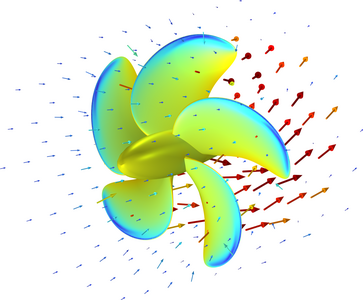
A propeller is the propulsion device of a ship. This model studies the open water performance of the KP505 propeller[1]using the frozen rotor method with RANS turbulence model. Thrust and torque coefficient, and open water efficiency of the propeller at different advance coefficients ... En savoir plus
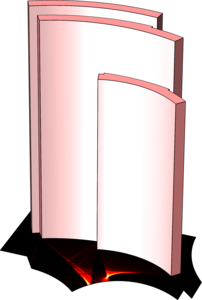
When the Vdara hotel first opened in Las Vegas, visitors relaxing by the pool would experience intense periods of heat at certain times of the day, at certain times of the year. This intense heat was caused by the reflection of solar radiation from the curved, reflective surface on the ... En savoir plus
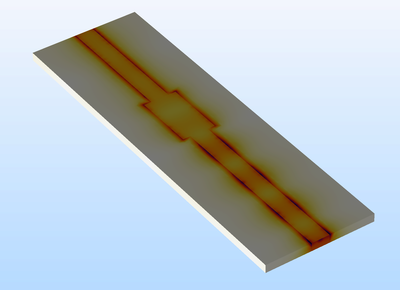
While transient analyses are useful for time domain reflectometry (TDR) to handle signal integrity (SI) problems, many RF and microwave examples are addressed using frequency domain simulations generating S-parameters. However, from the frequency domain data it is difficult to identify ... En savoir plus
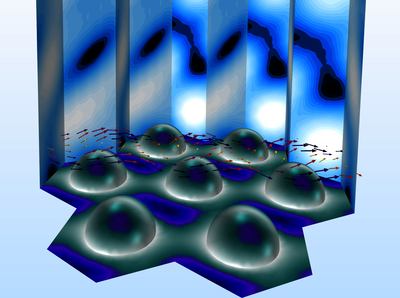
A plane wave is incident on a reflecting hexagonal grating. The grating cell consists of a protruding semisphere. The scattering coefficients for the different diffraction orders are calculated for a few different wavelengths. En savoir plus
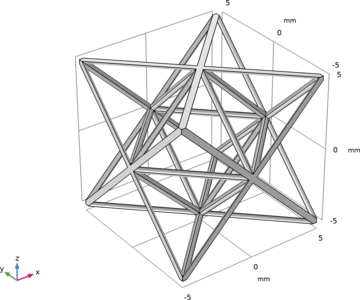
Lattice structures enable the creation of advanced materials for additive manufacturing with customized mechanical properties. At the macroscopic level, these structures can be modeled as homogeneous materials using homogenization techniques that determine their effective material ... En savoir plus
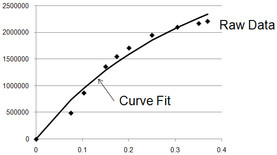
This presentation shows how to use the Optimization Module to fit a material model curve to experimental data. It is based on the hyperelastic Mooney-Rivlin material model example given in the Structural Mechanics users guide. En savoir plus
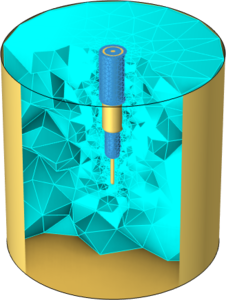
This model compares the results of five different formulations and approaches to solving an RF heating problem consisting of a coaxial cable inserted into a sample of lossy dielectric material. Results show that the different formulations agree over a wide frequency band. To learn more ... En savoir plus

This example compares moisture transport within two types of anisotropic porous medium. The first component defines a layered structure. The structure alternates between layers with high and low moisture diffusivity. So the moisture spreads more easily along the layers than transversely. ... En savoir plus
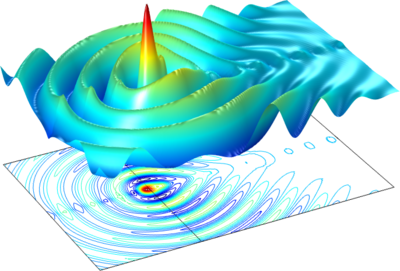
This is a benchmark model for the linearized Euler interface of the Acoustics Module. The model is from the NASA "Fourth Computational Aeroacoustics (CAA) Workshop on Benchmark Problems (2004)". The model results are compared to an analytical solution by Agarwal et al. (AIAA Vol. 42, No. ... En savoir plus
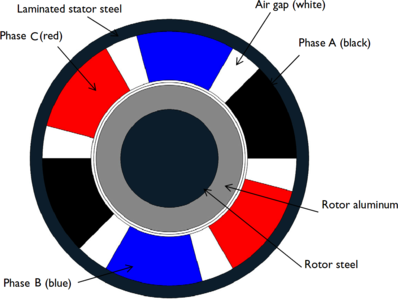
This is an example of a model of an induction motor in which the eddy currents are induced in the rotor by the time harmonic currents on the stator windings and the rotation of the rotor. In this example, we analyze the induction motor in 2D using the transient solver in the Rotating ... En savoir plus


