
La Bibliothèque d'Applications présente des modèles construits avec COMSOL Multiphysics pour la simulation d'une grande variété d'applications, dans les domaines de l'électromagnétisme, de la mécanique des solides, de la mécanique des fluides et de la chimie. Vous pouvez télécharger ces modèles résolus avec leur documentation détaillée, comprenant les instructions de construction pas-à-pas, et vous en servir comme point de départ de votre travail de simulation. Utilisez l'outil de recherche rapide pour trouver les modèles et applications correspondant à votre domaine d'intérêt. Notez que de nombreux exemples présentés ici sont également accessibles via la Bibliothèques d'Applications intégrée au logiciel COMSOL Multiphysics® et disponible à partir du menu Fichier.

The mutual inductance between a primary and secondary single turn coil in a concentric coplanar arrangement is computed using a DC, steady-state, model and compared against the analytic solution. The induced currents in the secondary coil are computed using an AC, frequency-domain, ... En savoir plus

In many structural dynamics applications, some components are stiff compared to the supporting structure. Such a stiff part will only contribute to the dynamic properties of the structure through its mass and moment of inertia. It is then possible to reduce the model size significantly ... En savoir plus
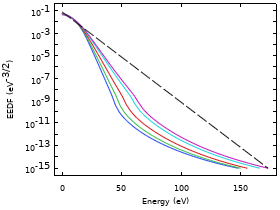
This tutorial models an ICP reactor by solving plasma fluid type equations fully coupled with the homogeneous and time-independent electron Boltzmann equation in the classical two-term approximation. The approximated Boltzmann equation is solved for each position of space and is coupled ... En savoir plus
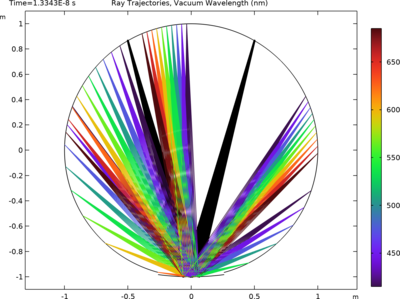
The Rowland circle is a circle of radius R that lies tangent to a concave curved diffraction grating of radius 2R. If the entrance slit of incoming light is positioned on this circle, then rays reflected by the grating will be focused at various points along the same circle based on ... En savoir plus
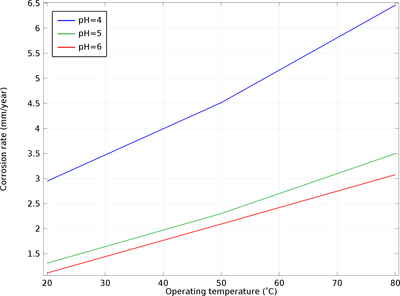
Carbon dioxide in aqueous solution is highly corrosive and can cause significant damage to steel designs. Such conditions arise in pipes used in a variety of applications, especially within the petrochemical industry. In this tutorial example, turbulent flows consisting of carbon ... En savoir plus
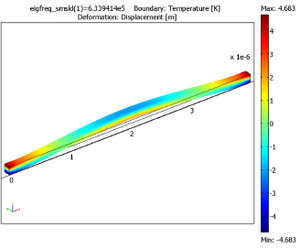
Thermoelastic damping, which arises when you subject a material to cyclic stress, is an important factor when designing MEMS resonators. The stress brings about deformation, where materials heat under compressive stress and cool under tensile stress. Thus, due to the resulting heat flux, ... En savoir plus
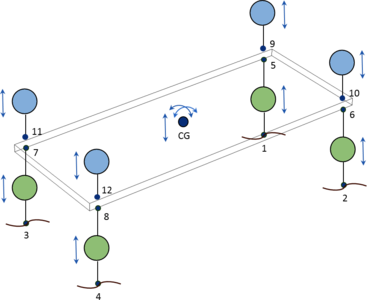
In this example, a lumped model of a vehicle suspension system having 11 degrees of freedom is analyzed. The Mass, Spring, and Damper nodes of the Lumped Mechanical System interface are used to model the wheels, including suspension system as well as the seats with a passenger. The ... En savoir plus
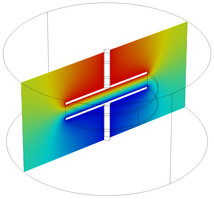
A capacitor with an applied sinusoidally time-varying voltage difference is modeled. A wide frequency range is considered and the impedance of the device is computed. Solver accuracy is addressed. The relationship between the frequency domain impedance and the steady-state capacitance ... En savoir plus


