
La Bibliothèque d'Applications présente des modèles construits avec COMSOL Multiphysics pour la simulation d'une grande variété d'applications, dans les domaines de l'électromagnétisme, de la mécanique des solides, de la mécanique des fluides et de la chimie. Vous pouvez télécharger ces modèles résolus avec leur documentation détaillée, comprenant les instructions de construction pas-à-pas, et vous en servir comme point de départ de votre travail de simulation. Utilisez l'outil de recherche rapide pour trouver les modèles et applications correspondant à votre domaine d'intérêt. Notez que de nombreux exemples présentés ici sont également accessibles via la Bibliothèques d'Applications intégrée au logiciel COMSOL Multiphysics® et disponible à partir du menu Fichier.
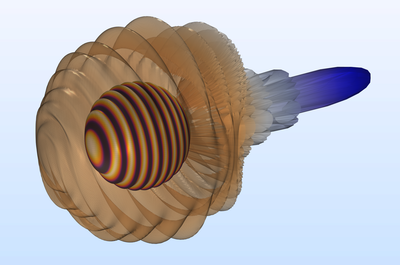
This example uses asymptotic techniques to study the radar cross-section (RCS) response of a conductive sphere. The selected physics interface transforms the incident plane-wave field on the boundaries to the far-field using the Stratton–Chu formula. The computed results are compared to ... En savoir plus
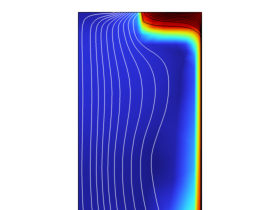
In this first half of a two-part example, a 2D model of a trench-gate IGBT is built, which will be extended to 3D in the second half. In general, it is the most efficient to start with a 2D model to make sure everything works as expected, before extending it to 3D. The Caughey&ndash ... En savoir plus
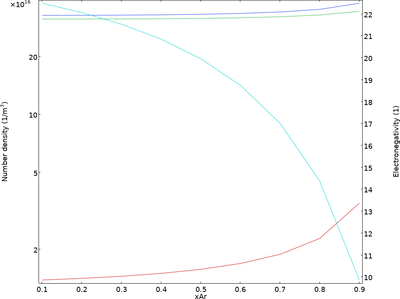
In this example, an SF6/argon plasma reactor at moderate pressure is studied using a global model. The heavy species heat equation is included. Parametric sweeps for input power and argon mole fraction are computed. En savoir plus
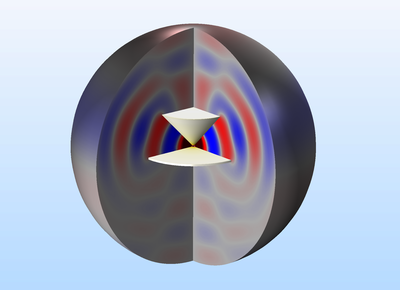
Conical antennas are useful for many applications due to their broadband characteristics and relative simplicity. In this example, we study the antenna impedance and radiation pattern as functions of frequency for a monoconical antenna with a finite ground plane and a 50 ohm coaxial ... En savoir plus
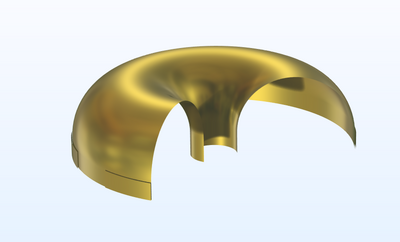
This tutorial demonstrates how to model a gyroscope based on the birdbath resonator gyroscope (BRG) design. The BRG is a type of Coriolis vibratory gyroscope (CVG) invented at the University of Michigan as a navigation-grade gyroscope in the mm-scale. This tutorial shows how the ... En savoir plus
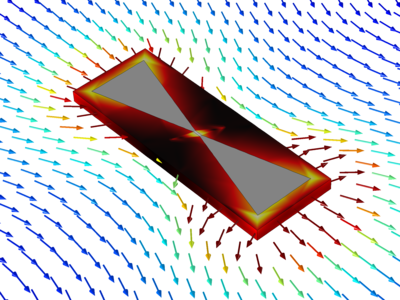
A bow-tie antenna patterned on a dielectric substrate is optimized by adjusting the length of the arms and the flare angle to reduce the magnitude of S11, reflection coefficient. The two geometric dimensions used as design variables directly control the antenna's size and shape, and also ... En savoir plus
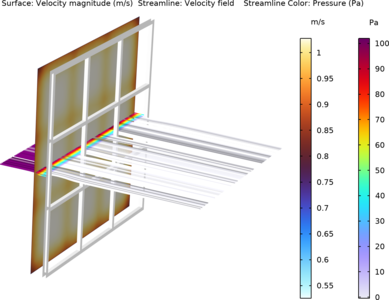
This example demonstrates simulation of a turbulent flow in a geometry with an air filter. Porous material of the filter induces an abrupt pressure drop and drastic increase of turbulence level inside the filter. En savoir plus
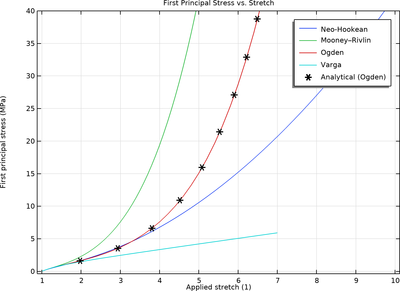
This model demonstrates the inflation of a rubber balloon with four different hyperelastic material models. The results are compared with the analytical solution for a thin-walled, spherical vessel. Controlling the inflation of hyperelastic balloons is important in clinical ... En savoir plus


