
La Bibliothèque d'Applications présente des modèles construits avec COMSOL Multiphysics pour la simulation d'une grande variété d'applications, dans les domaines de l'électromagnétisme, de la mécanique des solides, de la mécanique des fluides et de la chimie. Vous pouvez télécharger ces modèles résolus avec leur documentation détaillée, comprenant les instructions de construction pas-à-pas, et vous en servir comme point de départ de votre travail de simulation. Utilisez l'outil de recherche rapide pour trouver les modèles et applications correspondant à votre domaine d'intérêt. Notez que de nombreux exemples présentés ici sont également accessibles via la Bibliothèques d'Applications intégrée au logiciel COMSOL Multiphysics® et disponible à partir du menu Fichier.
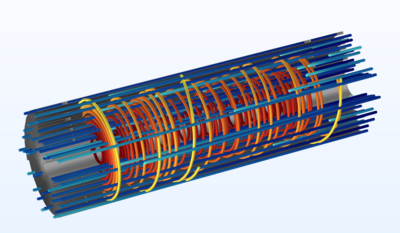
This example models a small reverse osmosis water desalination unit. The unit consists of a spirally wound semi-permeable membrane through which the water is forced under high pressure. The membrane retains the salt, such that on the permeate side fresh water is produced and on the ... En savoir plus
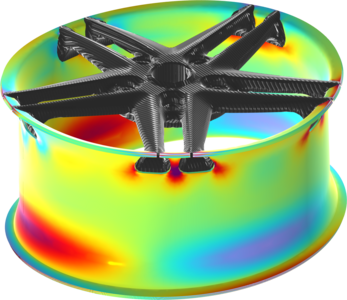
Nowadays, there is a trend to manufacture wheel rim made up of a composite material instead of aluminum. The primary reason is to have lower values of unsprung mass which leads to faster response time and thus better acceleration, braking and cornering performances. Typically a carbon ... En savoir plus
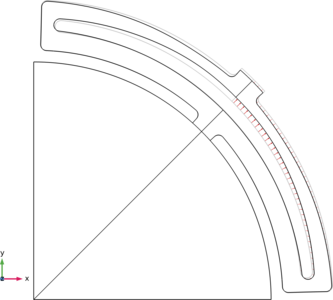
This model demonstrates how to tune the lowest natural frequency of the diaphragm of a MEMS microphone using Shape Optimization. The Stationary then Eigenfrequency study modifies the shape of the suspension springs that support the diaphragm. Although the model is in 3D, shape change is ... En savoir plus
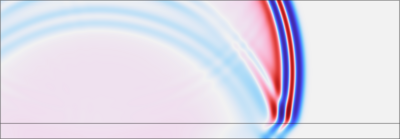
This tutorial studies the propagation of sound in the presence of a porous absorber in the time domain. It demonstrates how to model a porous absorber using the local and extended reacting approximations and compares the two approaches for absorbers of various thickness. The dissipative ... En savoir plus
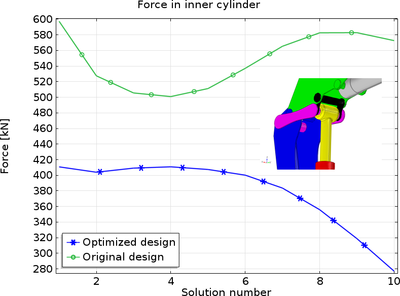
In complex mechanical systems, it can be challenging to find an optimal (or even good enough) solution only through engineering insight or trial-and-error procedures. Using mathematical optimization methods can then be an efficient path to a better design. In this example, a link ... En savoir plus
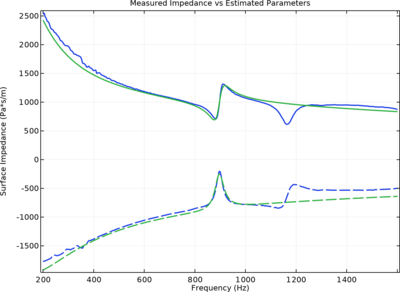
This app is an example of how the poroelastic properties of a porous material can be determined based on measurement done with an impedance tube and parameter estimation. Being able to determine the characteristics of a porous material from a single and simple measurement opens the door ... En savoir plus
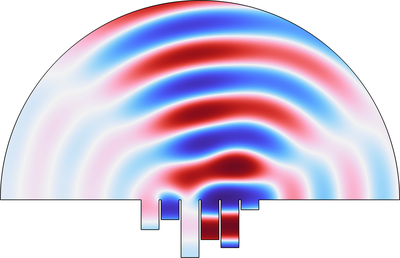
In this model, the scattering coefficient of a Schroeder diffuser is calculated. This coefficient can then be used as input to express boundary conditions in typical room acoustic simulations. The effect of periodicity is also investigated by studying the responses from different ... En savoir plus
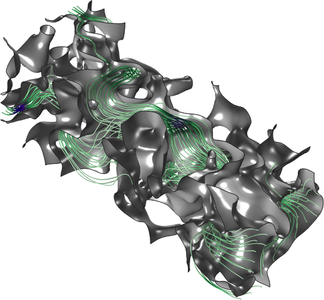
Modeling flow through realistic porous structures is difficult due to the complexity of the structure itself. Often, resolving the flow field in detail is not feasible; therefore, a macroscopic description of the pore scale structure, which utilize averaged quantities such as porosity ... En savoir plus
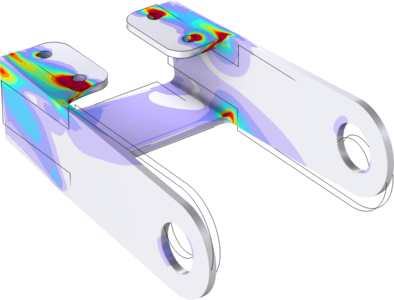
The bracket model tutorials are used as an introduction to the features and functionality within the Structural Mechanics Module. The following features are introduced: The following features are introduced: The fundamentals: static linear analysis Parametric study Including initial ... En savoir plus
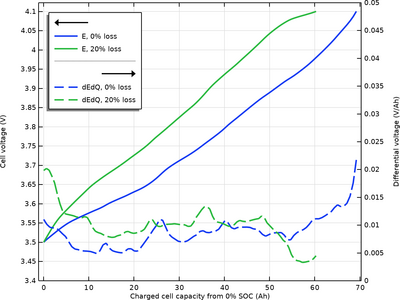
How the open-circuit voltage (OCV) of a lithium-ion battery varies with the state of charge is governed by various physical properties such as the thermodynamics of the electrode reactions, the relative capacities of the electrode materials, and the amount of cyclable lithium, but also ... En savoir plus


