
La Bibliothèque d'Applications présente des modèles construits avec COMSOL Multiphysics pour la simulation d'une grande variété d'applications, dans les domaines de l'électromagnétisme, de la mécanique des solides, de la mécanique des fluides et de la chimie. Vous pouvez télécharger ces modèles résolus avec leur documentation détaillée, comprenant les instructions de construction pas-à-pas, et vous en servir comme point de départ de votre travail de simulation. Utilisez l'outil de recherche rapide pour trouver les modèles et applications correspondant à votre domaine d'intérêt. Notez que de nombreux exemples présentés ici sont également accessibles via la Bibliothèques d'Applications intégrée au logiciel COMSOL Multiphysics® et disponible à partir du menu Fichier.

This app demonstrates the following: Geometry parts and parameterized geometry A results table form object containing outputs Finned pipes are used for coolers, heaters, or heat exchangers to increase heat transfer. They come in different sizes and designs depending on the ... En savoir plus
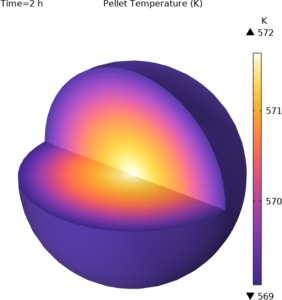
1D model of a thermal energy storage (TES) system consisting of a packed bed of pellets. Three approaches for heat transfer in porous media are compared: A one-equation local thermal equilibrium (LTE) model A two-equations local thermal nonequilibrium (LTNE) model A multiscale ... En savoir plus
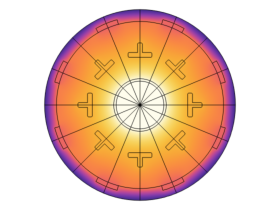
This model illustrates an application that maximizes surface-to-surface radiative fluxes and minimizes conductive heat fluxes. A thermo-photo-voltaic (TPV) cell generates electricity from the combustion of fuel and through radiation. The fuel burns inside an emitting device that ... En savoir plus
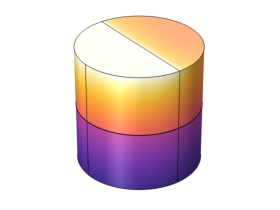
This example shows how to set up multiple sandwiched thin layers with different thermal conductivities in two different ways. First, the composite is modeled as a 3D object. In the second approach the Thin Layer boundary condition with the thermally thick option is used to avoid ... En savoir plus
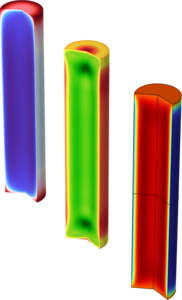
A steel billet is quenched in oil from its austenitic state. A 2D axisymmetric model is used to simulate the coupled problem of austenite decomposition, heat transfer, and solid mechanics. During the quenching process, the austenite decomposes into a combination of ferrite, pearlite, ... En savoir plus
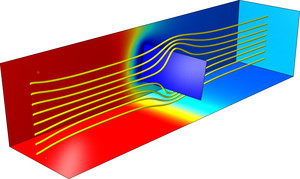
Chemical vapor deposition (CVD) allows a thin film to be grown on a substrate through molecules and molecular fragments adsorbing and reacting on a surface. This example illustrates the modeling of such a CVD reactor where triethyl-gallium first decomposes, and the reaction products ... En savoir plus

Fluence rate is a key parameter for ultraviolet (UV) water purifier. It describes the amount of radiation that pathogens absorb and is then directly related to the disinfection level of the purifier. The aim of this example is to demonstrate the fluence rate calculation with the ... En savoir plus
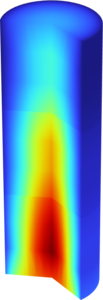
This model simulates a cylindrical furnace with isotropic scattering. It validates the use of the Discrete Ordinates Method for 2D axisymmetric cases, comparing the results with the highly accurate Monte Carlo method. The setup and reference Monte Carlo values are given in: R .P. Gupta, ... En savoir plus
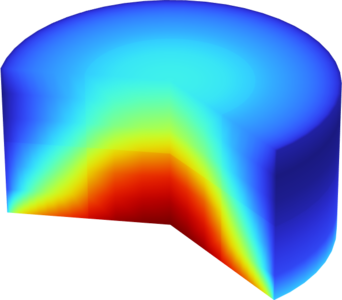
This model simulates a cylindrical furnace with isotropic scattering. It validates the use of the Discrete Ordinates Method for 2D axisymmetric cases, comparing the results with the highly accurate Monte Carlo method. The setup and reference Monte Carlo values are given in: R .P. Gupta, ... En savoir plus
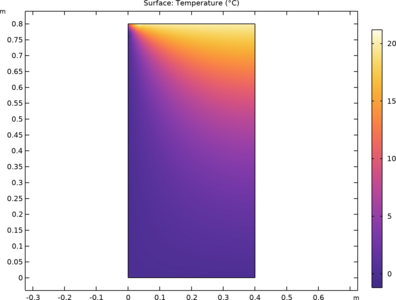
This example studies heat transfer in a square column. Cold and hot temperature conditions are applied to the boundaries. Due to the symmetry of the problem, the geometry is simplified to half of the square. The temperature field is compared with the analytic data. This example ... En savoir plus