
La Bibliothèque d'Applications présente des modèles construits avec COMSOL Multiphysics pour la simulation d'une grande variété d'applications, dans les domaines de l'électromagnétisme, de la mécanique des solides, de la mécanique des fluides et de la chimie. Vous pouvez télécharger ces modèles résolus avec leur documentation détaillée, comprenant les instructions de construction pas-à-pas, et vous en servir comme point de départ de votre travail de simulation. Utilisez l'outil de recherche rapide pour trouver les modèles et applications correspondant à votre domaine d'intérêt. Notez que de nombreux exemples présentés ici sont également accessibles via la Bibliothèques d'Applications intégrée au logiciel COMSOL Multiphysics® et disponible à partir du menu Fichier.
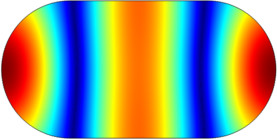
In this model, compute the propagating modes in the chamber of an automotive muffler. The geometry is a cross-section of the chamber in the Absorptive Muffler example. The model’s purpose is to study the shape of the propagating modes and to find their cut-off frequencies. As discussed ... En savoir plus
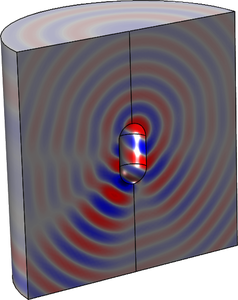
The problem of a plane wave scattering off a cylinder-shaped object suggests the use of the 2D axisymmetric formulation. This can save computation time and reduce the memory usage compared to the model in 3D space. This example demonstrates the use of the built-in plane wave expansion ... En savoir plus
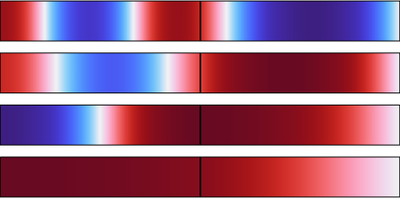
This tutorial demonstrates how to model the interaction between an acoustic field and the heat release from a flame, using the Flame Model domain feature. Modeling this interaction is important in order to understand and predict unstable acoustic modes in gas turbines and jet engines. ... En savoir plus
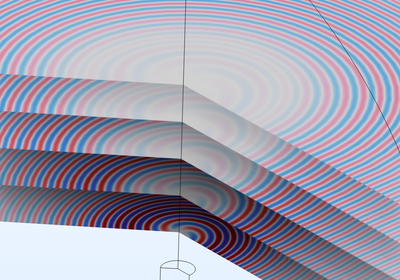
Model of the sound radiation from a circular duct with uniform flow. The convected acoustic problem is described using the linearized potential flow equations, solved in the frequency domain. The acoustic inlet is treated including higher order modes using the Port boundary condition and ... En savoir plus

When high-fidelity measurement microphones are calibrated, a pressure reciprocity calibration method is used. During calibration, two microphones are connected at each end of a closed cylindrical cavity. For the calibration procedure, it is important to understand the acoustic field ... En savoir plus
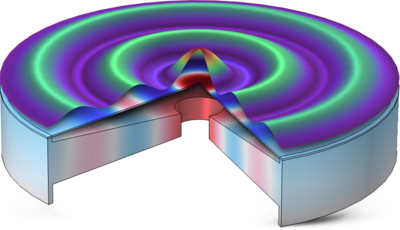
This example of a simple axisymmetric condenser microphone includes all the relevant physics and determines the microphone sensitivity as well as microphone capacitance for the specific simplified microphone geometry and material parameters. It solves a fully coupled multiphysics model ... En savoir plus

A plane-wave mode feeds an axisymmetric horn radiating from an infinite baffle toward an open half space. The radius of the waveguide attached to the horn throat is assumed to be fixed, as well as the depth of the horn and the size of the horn mouth attached to the baffle. By varying the ... En savoir plus
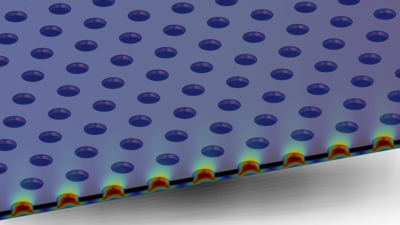
This tutorial model is of a micro perforated plate (also known as MPP) backed by a vibrating structure. This is a typical configuration in, for example, a MEMS microphone. The vibrating structure is not modeled explicitly, but just assigned a vibration velocity. The vibrating structure ... En savoir plus
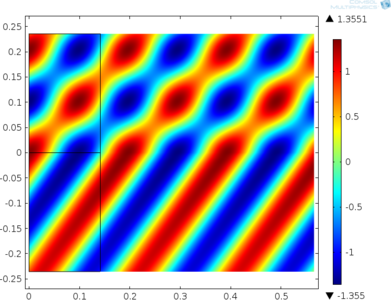
This model determines the reflection coefficient of plane acoustic waves, at different frequencies and at different angles of incidence, off a water-sediment interface. The ability of the Poroelasitc Waves interface to model the coupled acoustic and elastic wave in any porous substance ... En savoir plus
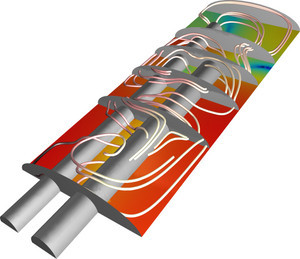
Reflective mufflers are best suited for the low-frequency range where only plane waves can propagate in the system, while dissipative mufflers with fibers are efficient in the mid- to high-frequency range. Dissipative mufflers based on flow losses, on the other hand, also work at low ... En savoir plus


