
La Bibliothèque d'Applications présente des modèles construits avec COMSOL Multiphysics pour la simulation d'une grande variété d'applications, dans les domaines de l'électromagnétisme, de la mécanique des solides, de la mécanique des fluides et de la chimie. Vous pouvez télécharger ces modèles résolus avec leur documentation détaillée, comprenant les instructions de construction pas-à-pas, et vous en servir comme point de départ de votre travail de simulation. Utilisez l'outil de recherche rapide pour trouver les modèles et applications correspondant à votre domaine d'intérêt. Notez que de nombreux exemples présentés ici sont également accessibles via la Bibliothèques d'Applications intégrée au logiciel COMSOL Multiphysics® et disponible à partir du menu Fichier.
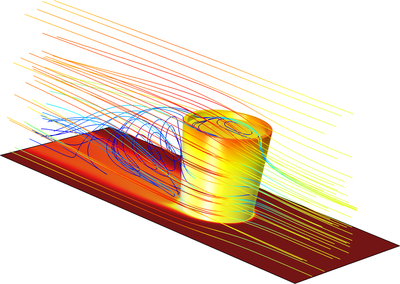
This tutorial shows how to couple three physics interfaces to model evaporative cooling. The effects that need to be taken into account are heat transfer, transport of water vapor, and fluid flow. The Wet Surface feature is used to implement the source term for the water vapor and to ... En savoir plus

This is a conceptual model illustrating how to couple fluid-structure interaction, heat transfer, and thermal expansion. A bimetallic strip in an air channel is heated so that it bends. After some time, an airflow with an inlet temperature which varies in time is introduced. As a ... En savoir plus
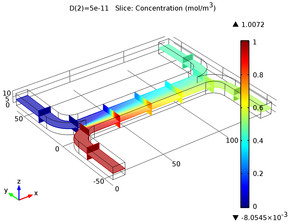
This model simulates an H-shaped micro-cell designed for diffusion-controlled separation. The cell puts two different laminar streams in contact for a controlled period of time. The contact surface is well-defined and, by controlling the flow rate, it is possible to control the amount of ... En savoir plus
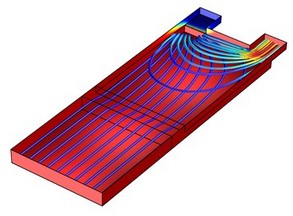
Thermal management has become a critical aspect of today’s electronic systems, which often include many high-performance circuits that dissipate large amounts of heat. Many of these components require efficient cooling to prevent overheating. Some of these components, such as processors, ... En savoir plus
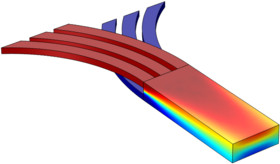
At the macroscopic level, systems usually mix fluids using mechanical actuators or turbulent 3D flow. At the microscale level, however, neither of these approaches is practical or even possible. This model demonstrates the mixing of fluids using laminar-layered flow in a MEMS mixer. This ... En savoir plus
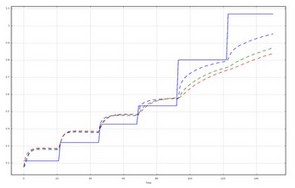
The first model describes the simultaneous flow of two immiscible fluids in porous media - here air displaces water in a multi-step inlet pressure experiment. We solve for the pressure and the degree saturation for the air and water within a representative volume and so track saturation ... En savoir plus
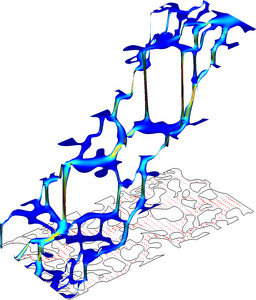
This non-conventional model of porous media flow utilizes creeping (Stokes) flow in the interstices of a porous media. The model comes from the pore-scale flow experiments conducted by Arturo Keller, Maria Auset, and Sanya Sirivithayapakorn of the University of California, Santa Barbara. ... En savoir plus

Micromixers can either be static or dynamic depending on the required mixing time and length scale. For static mixers, the Reynolds number has to be suitable high to induce turbulence enhanced mixing. Often micromixers operate in the laminar flow regime due to their small characteristic ... En savoir plus
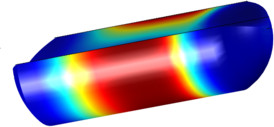
This example describes the operation of a drug delivery system that supplies a variable concentration of a water soluble drug. A droplet with a fixed volume of water travels down a capillary tube at a constant velocity. Part of the capillary wall consists of a permeable membrane ... En savoir plus
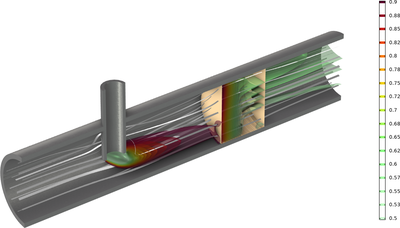
Modeling packed beds, monolithic reactors, and other catalytic heterogeneous reactors is substantially simplified with the Reacting Flow in Porous Media multiphysics interface. This defines the diffusion, convection, migration, and reaction of chemical species for porous media flow ... En savoir plus


