
La Bibliothèque d'Applications présente des modèles construits avec COMSOL Multiphysics pour la simulation d'une grande variété d'applications, dans les domaines de l'électromagnétisme, de la mécanique des solides, de la mécanique des fluides et de la chimie. Vous pouvez télécharger ces modèles résolus avec leur documentation détaillée, comprenant les instructions de construction pas-à-pas, et vous en servir comme point de départ de votre travail de simulation. Utilisez l'outil de recherche rapide pour trouver les modèles et applications correspondant à votre domaine d'intérêt. Notez que de nombreux exemples présentés ici sont également accessibles via la Bibliothèques d'Applications intégrée au logiciel COMSOL Multiphysics® et disponible à partir du menu Fichier.
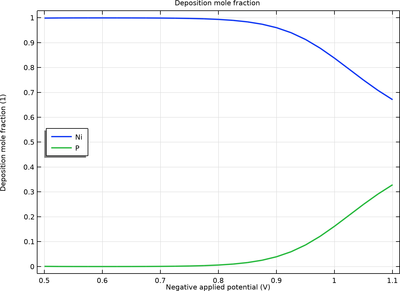
Electrochemical codeposition is a common low-cost method for producing metal alloys. This tutorial model demonstrates electrodeposition of a nickel (Ni)–phosphorous (P) alloy. The model accounts for charge and mass transport of a multitude of species along with multiple electrode ... En savoir plus
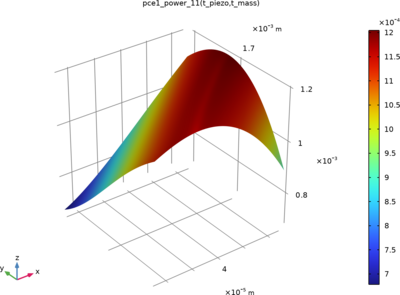
Uncertainty Quantification (UQ) is used to study the effect of manufacturing variation on the performance of Piezoelectric Energy Harvester. This tutorial shows how UQ studies are specified for a frequency domain study that calculates the energy harvester's power output. En savoir plus
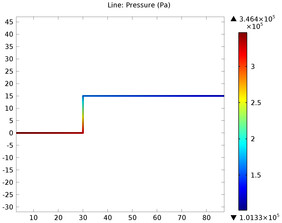
This tutorial model illustrates how to calculate the pressure drop and initial flow rate in a pipe system connected to water tank. The Pipe Flow interface contains ready to use friction models accounting for the surface roughness of pipes as well as pressure losses in bends and valves. En savoir plus

Basin-type insulators are essential components in Gas-Insulated Metal-Enclosed Switchgear (GIS). During manufacturing, the epoxy resin curing process can generate residual stresses that may lead to crack formation. Over time, such cracks can trigger partial discharges, degrading the ... En savoir plus
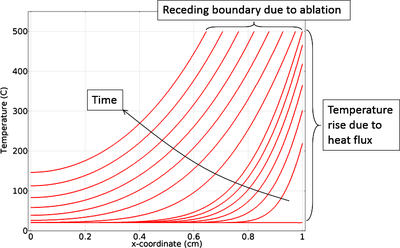
This example exemplifies how to model thermal ablation by taking into account material removal. A more detailed description of the phenomenon and the modeling process can be seen in the blog post "Modeling Thermal Ablation for Material Removal". En savoir plus

An acousto-optic modulator (AOM) is a device which can be used for controlling the power, frequency or spatial direction of a laser beam with an electrical drive signal. It is based on the acousto-optic effect, that is, the modification of the refractive index by the oscillating ... En savoir plus
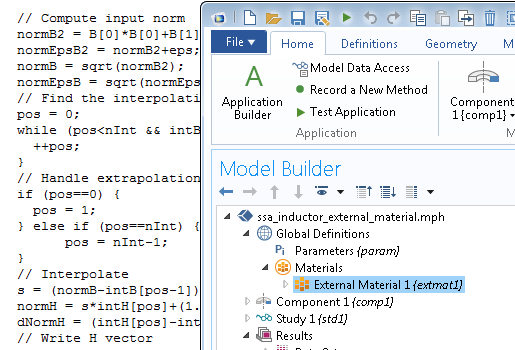
The AC/DC magnetic interfaces support material models defined in external C code. You can access external material functions, written in C code, which have been compiled into a shared library. By writing a wrapper function in C code, you can also use material functions written in another ... En savoir plus
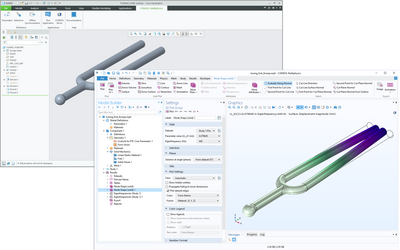
This model computes the fundamental eigenfrequency and eigenmode for a tuning fork that is synchronized from PTC Creo Parametric™ via the LiveLink™ interface. The length of the fork is then optimized so that the tuning fork sounds the note A, 440 Hz. En savoir plus


