
La Bibliothèque d'Applications présente des modèles construits avec COMSOL Multiphysics pour la simulation d'une grande variété d'applications, dans les domaines de l'électromagnétisme, de la mécanique des solides, de la mécanique des fluides et de la chimie. Vous pouvez télécharger ces modèles résolus avec leur documentation détaillée, comprenant les instructions de construction pas-à-pas, et vous en servir comme point de départ de votre travail de simulation. Utilisez l'outil de recherche rapide pour trouver les modèles et applications correspondant à votre domaine d'intérêt. Notez que de nombreux exemples présentés ici sont également accessibles via la Bibliothèques d'Applications intégrée au logiciel COMSOL Multiphysics® et disponible à partir du menu Fichier.
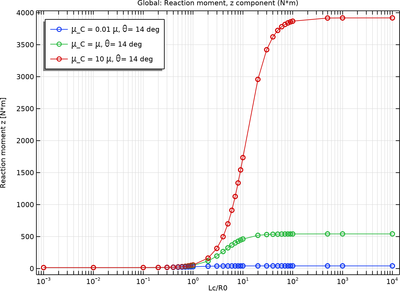
In this example, it is demonstrated how to extend the built-in linear elastic material model to a Cosserat material through the addition of microrotation degrees of freedom. A cylindrical bar under pure torsion is analyzed and the effect of the Cosserat length scale parameter on the ... En savoir plus
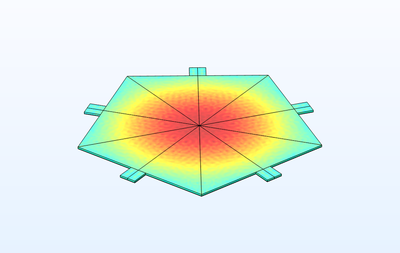
This tutorial demonstrates how an electrical circuit model of a MEMS resonator can be derived using the Parameter Estimation feature. The model is a modified Butterworth-Van Dyke circuit created using the Electrical Circuit interface and represents a Thin-Film Bulk Acoustic Resonator ... En savoir plus
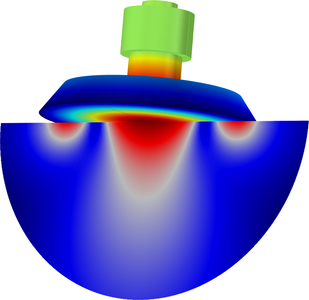
A tonpilz transducer is used for relatively low frequency, high power sound emission. It is one of the popular transducer configurations for SONAR applications. The transducer consists of piezoceramic rings stacked between a head mass and a tail mass which are connected by a central ... En savoir plus
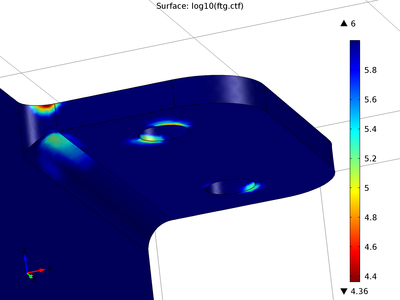
The S–N curve, also called the Wöhler curve, is one of the most popular methods for fatigue evaluation. The curve relates stress amplitude to the limiting fatigue life and can be obtained directly from a set of standard fatigue test. Many times our applications are subjected to ... En savoir plus

A classical flow pattern is the von Kármán vortex street that can form as fluid flows past an object. These vortices may induce vibrations in the object. This problem involves a fluid-structure interaction where the large deformation affect the flow path. The magnitude and the ... En savoir plus
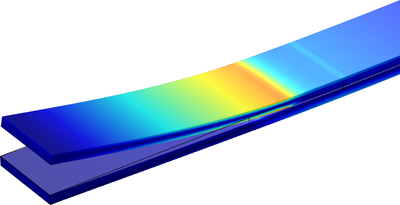
Interfacial failure by delamination or debonding can be simulated with a Cohesive Zone Model (CZM). This example shows the implementation of a CZM with a bilinear traction-separation law. It is used to predict the mixed-mode softening onset and delamination propagation in a composite ... En savoir plus
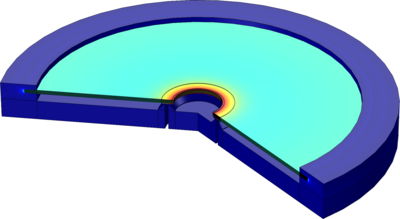
Piezoelectric valves are frequently employed in medical and laboratory applications due to their fast response times and quiet operation. Their energy efficient operation, also dissipates little heat, which is often important for these applications. This model shows how to model a ... En savoir plus
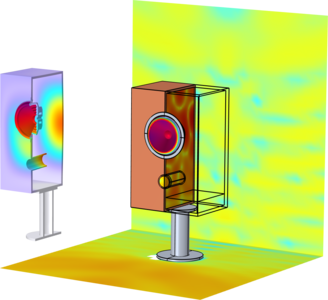
This model shows a full vibroacoustic analysis of a loudspeaker including driver, cabinet, and stand. It lets you apply a nominal driving voltage and extract the resulting sound pressure level in the cabinet and in the outside room, as well as the deformation of the cabinet and driver, ... En savoir plus
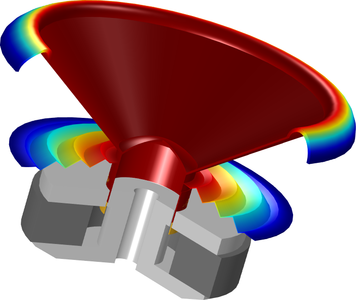
This example shows how to model a loudspeaker driver of the dynamic cone type, common for low and medium frequencies. The analysis is carried out in the frequency domain and thus represents the linear behavior of the driver. The model analysis includes the total electric impedance and ... En savoir plus
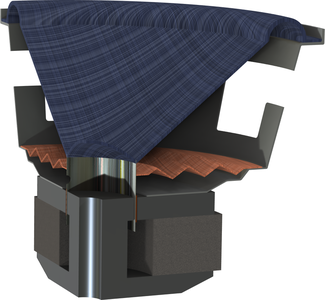
This tutorial shows how to best solve full 3D vibro-electroacoustic multiphysics models of loudspeakers. The model is based on a 3D representation of the existing 2D axisymmetric Application Library model loudspeaker_driver found in the software. The setup of the physics is essentially ... En savoir plus